
The safest way to distribute merchandise at conferences is to control five things together: where stock may move, who qualifies, when each allocation is released, what data is collected and what happens to leftovers. Put those decisions on one Booth Control Board: Space × Eligibility × Release × Data × Exit. Give every staff member the same short rule card, separate working stock from a sealed reserve and release merchandise by daypart instead of exposing the full supply at opening.
This method keeps handovers consistent during rushes, protects premium items for their intended recipients and leaves a usable record for the next day. It does not replace budgeting or order planning. It turns an approved merchandise quantity into a booth process that staff can execute and the event lead can audit.
Put the Operating Decisions on One Board
Budget and quantity should already be settled before the onsite team builds its control system. If those decisions remain open, use the LUGVO guides to conference giveaway budget per attendee και event merchandise quantity planning first. The Booth Control Board does not recalculate either figure. It governs the inventory already approved.
The board can be printed, written on a whiteboard or kept in a shared tablet view. It must remain visible to the booth lead and understandable at a glance.
| Control | Decision kept visible |
|---|---|
| Space | Where may each item be stored, displayed or handed over? |
| Eligibility | What observable action qualifies a visitor for it? |
| Release | What is available now, and what remains sealed? |
| Data | What information, if any, is necessary for this handover? |
| Exit | Who owns remaining stock, and where will it go? |
Give each merchandise tier or SKU one row. Record its current location, eligibility condition, released stock, sealed reserve, permitted data action and disposition owner. Staff should not have to interpret campaign strategy while a queue is forming.
Reduce the Board to a Staff Rule Card
The rule card is the pocket version of the board. It states which items are open access, which require a defined visitor action, who can authorise an exception, where to record a handover and when replenishment may occur. It also gives staff an agreed response when the active allocation is unavailable.
Write observable conditions. “Completed the scheduled product demonstration” can be applied consistently. “Looks like a valuable prospect” cannot. If commercial qualification matters, define the criteria in the campaign brief and name the role authorised to confirm them.
The authority line matters just as much. A host may distribute the open-access item; the booth lead may approve premium merchandise and exceptions. Without that distinction, policy can change whenever a senior colleague, partner or persistent visitor asks for special treatment.
Before finalising the card, check the current organiser and venue manual. Rules are event-specific. For example, the AHR Expo Exhibitor Manual requires aisles to remain clear and restricts promotional material and giveaway distribution to the exhibitor’s allotted space. That is an AHR Expo requirement, not a universal industry rule, but it shows why booth flow must be checked against the event’s own instructions.
Make Space and Eligibility Do the First Line of Control
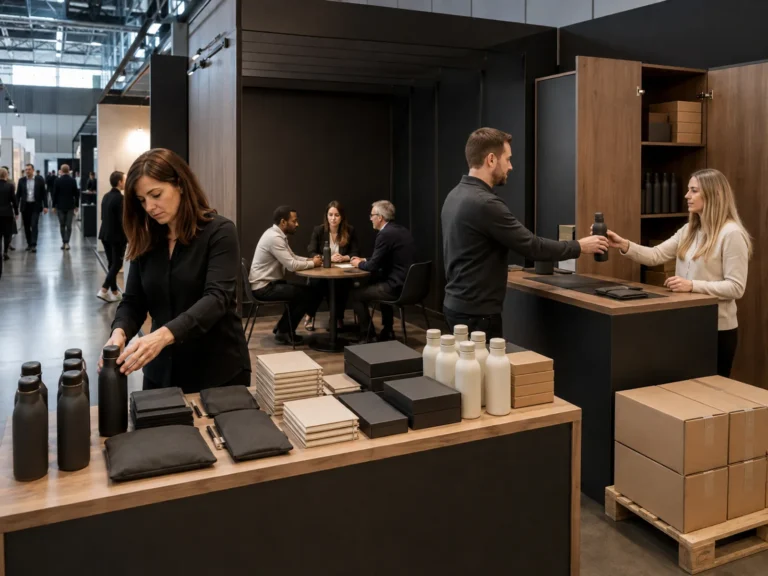
The physical booth should express the board’s logic. When every carton is visible, visitors assume everything is available. When open boxes sit beside the counter, staff replenish informally. A simple spatial plan removes both ambiguities.
Mark Five Booth Zones
Use five zones, even in a compact booth:
- Frontage is the public edge. It carries display samples and any genuinely open-access item. A display sample does not have to be available for immediate handover.
- Conversation is where discovery, demonstration or qualification happens. Merchandise should not turn every exchange into a negotiation about gifts.
- Handoff is the controlled transfer point. A staff member confirms eligibility, provides the item and records the distribution when required.
- Backstock holds released working inventory. Keep it outside visitor reach and separate it by SKU or tier.
- Exception contains premium items, replacements and named speaker, partner or customer allocations. It is not overflow storage; access is limited.
Tape marks inside a cabinet, labelled shelves and one designated counter position can create these zones without adding floor area. What matters is that an item cannot move straight from a sealed carton to a visitor without passing through release and eligibility decisions.

Use an Objective Eligibility Ladder
An eligibility ladder connects merchandise value to a verifiable action:
- Open access: available while the active release lasts, with no contact details required.
- Engagement: available after an observable activity such as attending a demonstration.
- Qualified conversation: available when an authorised team member confirms the campaign’s stated business criteria.
- Scheduled follow-up: available when both parties agree to a legitimate next step, such as a technical session.
- Named allocation: reserved for approved speakers, partners, customers or account teams.
The ladder is not a disguised contest, nor a reward for gathering arbitrary quantities of personal data. It exists to make decisions consistent. Two visitors who complete the same qualifying action should receive the same outcome, subject to the release status on the board.
If an item is unavailable, preserve the eligibility rule. Do not give the first person who complains a premium substitute. Offer an approved alternative, record deferred fulfilment only when the campaign supports it, or explain that the current allocation has closed.
Release Stock by Daypart and Keep the Record Lean
A shipment delivered to the venue is not automatically released to the booth. Separating possession from release protects later traffic, scheduled meetings and final-day commitments without asking frontline staff to ration stock by instinct.
Keep Future Allocations in a Sealed Reserve
Divide each day into periods that match the actual agenda: opening traffic, session intervals, lunch flow, demonstrations, reception hours or closing traffic. Do not invent universal percentages. The release pattern depends on the programme, booth objectives and approved quantity plan.
| Board line | Released now | Working backstock | Sealed reserve | Authority |
|---|---|---|---|---|
| Active daypart | Count by SKU | Count by SKU | Unopened and labelled | Booth lead |
| Next daypart | Not active | Prepared only if approved | Unchanged | Booth lead |
| Protected commitments | Separate allocation | Separate location | Not for general release | Named owner |
Give every release a time and an owner. If traffic differs from plan, the lead may move an unreleased allocation between later dayparts, but the change belongs on the board. An unopened carton never becomes available merely because the frontage supply looks low.
Replenish Through a Six-Step SOP
Keep replenishment short enough to use during a rush:
- The handoff position reports low working stock.
- A designated staff member counts what remains.
- The booth lead checks the active daypart and protected allocations.
- An approved quantity moves from working backstock to the handoff zone.
- The movement and new balance are recorded.
- Empty packaging is removed so it cannot be mistaken for live stock.
Only the booth lead opens sealed reserve. Damaged products, missing cartons, disputed eligibility or suspected loss leave the normal flow. Handle those cases through the separate trade show merchandise incident runbook; the booth distribution card should not become a second incident manual.
Separate Inventory Evidence From Personal Data
A merchandise handover does not automatically justify a badge scan, full lead form or newsletter enrolment. Collect only what the stated purpose requires. An anonymous unit count can support an open-access item. A qualified conversation may produce a normal CRM record when the visitor understands the intended follow-up. Post-event delivery may require a name and address, but those details do not create permission for unrelated marketing.
The European Commission’s principles of personal data processing under the GDPR include lawfulness, fairness and transparency; purpose limitation; data minimisation; storage limitation; accuracy; integrity and confidentiality; and accountability. Its data-minimisation guidance says personal data should be adequate, relevant and limited to what is necessary, and that anonymous data is preferable where possible. For a booth team, the practical implication is to make the merchandise process work with the least personal data reasonably needed for its stated purpose.
A tally by SKU, daypart and eligibility tier can explain distribution performance without creating a list of everyone who received an item.
Close Each Day Before Deciding the Exit
The final day should not trigger an uncontrolled giveaway. Avoiding return freight is a logistics concern, not an eligibility rule. Close the daily record first, then make a documented disposition decision.
Walk Through a Representative Three-Day Booth
Consider this representative scenario, not a universal allocation model.
On day one, the team places display samples at the frontage, releases working stock by agenda period and leaves reserve cartons sealed. Open-access items move quickly after the opening session. Premium merchandise stays linked to demonstrations and qualified conversations. The booth lead records one release adjustment after comparing traffic with the board.
On day two, staff retain the same eligibility ladder rather than loosening it because visitors have seen the merchandise. The replenishment record shows which SKU moved during demonstrations and which mostly attracted passing traffic. The lead shifts an unreleased daypart allocation while preserving named customer and partner commitments.
On day three, the team first reconciles physical stock, protected commitments and the exit plan. Only inventory explicitly approved for broader distribution changes status. Staff do not move every remaining carton to the frontage. Each SKU receives a destination before breakdown starts.

Assign custody to every remaining SKU.
The Exit column should contain only approved outcomes: return to the warehouse, transfer to another confirmed event, deliver named allocations, donate through an authorised channel, retain documented samples, or dispose of damaged goods under venue and company procedures. Name the person who approves the outcome and the person who receives custody.
After the event, reconcile opening inventory, recorded releases, handovers where required, damage, transfers and the closing physical count. Investigate variances instead of burying them in an estimated giveaway total.
The after-action review should examine decisions, not manufacture impressive metrics. Which eligibility wording caused confusion? Which zone allowed unauthorised access? Which daypart needed a release change? Did staff collect unnecessary information? Did the exit plan prevent rushed decisions? Feed those findings into the next event brief and the existing quantity-planning process.
LUGVO can develop merchandise, packaging and delivery options for international B2B event programmes. Share the event format, destinations, audience tiers and approved quantity through the LUGVO services page when you need a sourcing plan that fits this distribution system. The final operational test remains simple: every item should have a place, a release status, an eligibility rule and a named owner until it reaches its intended recipient or documented next destination.



 English
 Español
 Français
 العربية
 Italiano
 Deutsch
 日本語
 Nederlands
 Svenska
 Norsk bokmål
 Dansk
 Suomi
 한국어
 Ελληνικά
 עִבְרִית
 Română
 Türkçe
 Русский