
A trade show merchandise incident runbook should protect the business outcome, not preserve the original item at any cost. Before production starts, decide what happens if a sample fails, cargo misses its cut-off, the venue rejects a delivery, part of the stock is damaged or release runs too quickly. Give each failure a dated trigger, a protected outcome, an authorised alternative and one decision owner.
The plan becomes stricter as the event approaches. At T-21 days, there may still be time to change product or route. At T-7, the realistic choices narrow to protected waves, local substitutes and simplified presentation. On event morning, control and communication matter more than sourcing ambition. A written branch made in advance is faster and safer than a hurried group chat after the failure is already visible.
The plan that breaks at T-21
Consider a marketing team preparing 900 merchandise sets for a four-day technology conference in Lisbon. It has allocated 600 practical visitor items, 220 gifts for qualified conversations and 80 higher-value sets for speakers, partners and named meetings. This is a representative scenario, not a LUGVO customer order.
The event opens on 9 November. The official page states that Web Summit 2026 runs in Lisbon from 9 to 12 November. Twenty-one days before opening, the pre-shipment inspection finds inconsistent decoration on 35% of the qualified-conversation item. The supplier proposes reworking everything and keeping the original dispatch date.
That is not yet a recovery plan. The team needs to know how many compliant units already exist, how rework affects cargo release, whether a split is possible, which audience must be protected and who may approve a visible substitute. A promise to “try our best” leaves every decision until later, when fewer options remain.
Business-continuity practice offers a useful principle. ISO 22301:2019 describes a documented system for preparing for, responding to and recovering from disruptive incidents. An event merchandise runbook is much smaller and does not claim conformity with that standard, but it benefits from the same discipline: define acceptable operating capacity and recovery actions before disruption.
T-21 days: protect the business outcome
At this gate, ask what the merchandise is meant to enable. The answer might be visible participation, useful conversation, speaker recognition, scheduled client meetings or post-event follow-up. Products are replaceable; those outcomes and dates are not.

Branch on quality evidence
Trigger this branch when inspection, sample comparison or production records show that the released specification is not being met. First quarantine affected stock. Then count conforming units rather than applying the defect rate casually to the whole order.
The decision owner chooses among four controlled outcomes:
- release conforming units as a protected first wave;
- sort or rework only if the method and reinspection time are credible;
- replace the item with an approved alternative;
- remove the item and preserve the interaction through another format.
Do not lower an important safety, function or brand criterion solely because the event is close. A simpler neutral item can be better than an inconsistent product that makes the failure public. Record any concession, its scope and who accepted it.
Branch on route feasibility
Recalculate from the actual cargo-ready date. The existing guide to air versus sea freight for corporate gifts explains how to use safe cargo gates rather than headline transit. Here, the contingency question is narrower: what minimum quantity must arrive to operate the event, and what later quantity still has a genuine use?
For the representative programme, the team protects all 80 named sets and 140 of the qualified-conversation items. It adds 30 neutral visitor items for the opening morning. That 250-unit wave is not an arbitrary percentage; each piece has an owner and distribution purpose. The remainder can travel only if it still meets a valid delivery window. Stock that arrives after the event with no planned use is not a recovery.
T-7 days: release the recovery route
Seven days before the event, a sourcing team should stop discussing options that cannot now be sampled, produced, packed and delivered safely. The runbook moves from preferred product to minimum viable operation.
Use a pre-approved substitution ladder
Write substitutions while the campaign brief is still calm. A practical ladder might be:
- the approved product with simplified non-critical packaging;
- the same function in a stocked colour with locally applied branding;
- a neutral, useful item with a branded card or sleeve;
- a digital redemption linked to post-event delivery;
- no physical item where none of the alternatives protects quality or recipient experience.
Each step needs a ceiling for price, an artwork boundary, an approval owner and a statement of where it may be used. A neutral visitor item may be acceptable at a stand but not for a named executive meeting. A redemption route may suit a qualified conversation but create excessive data collection for passing traffic.
Substitution also affects communication. Staff should know what changed and why without apologising to every visitor for a product they never saw. Internal honesty is useful; public drama is not.
Freeze the hand-offs
At T-7, confirm who holds stock, who can release it, the final delivery address, venue receiving hours, vehicle or courier requirements, contact names, carton count and escalation channel. “Deliver to the exhibition centre” is not an operational instruction.
Create two locations if the event justifies it: working stock close to the stand and a controlled reserve elsewhere. Keep protected meeting gifts out of general visitor cartons. Photograph carton condition and record counts at each transfer. If the venue route fails, the authorised owner can redirect to the approved local staging point without waiting for a large committee.
En corporate gifting lead-time plan shows where freight, customs, kitting and final delivery sit in the wider critical path. The contingency runbook should reference that plan, not recreate it after every change.
Event morning: control what remains
At opening, procurement options are largely finished. The remaining work is allocation, observation and recovery from local incidents.
Release stock by rule
Begin with a counted opening quantity for each tier and keep the rest sealed. Give one stock controller authority to open reserve cartons. Record releases at fixed times rather than trying to reconstruct consumption after the event.
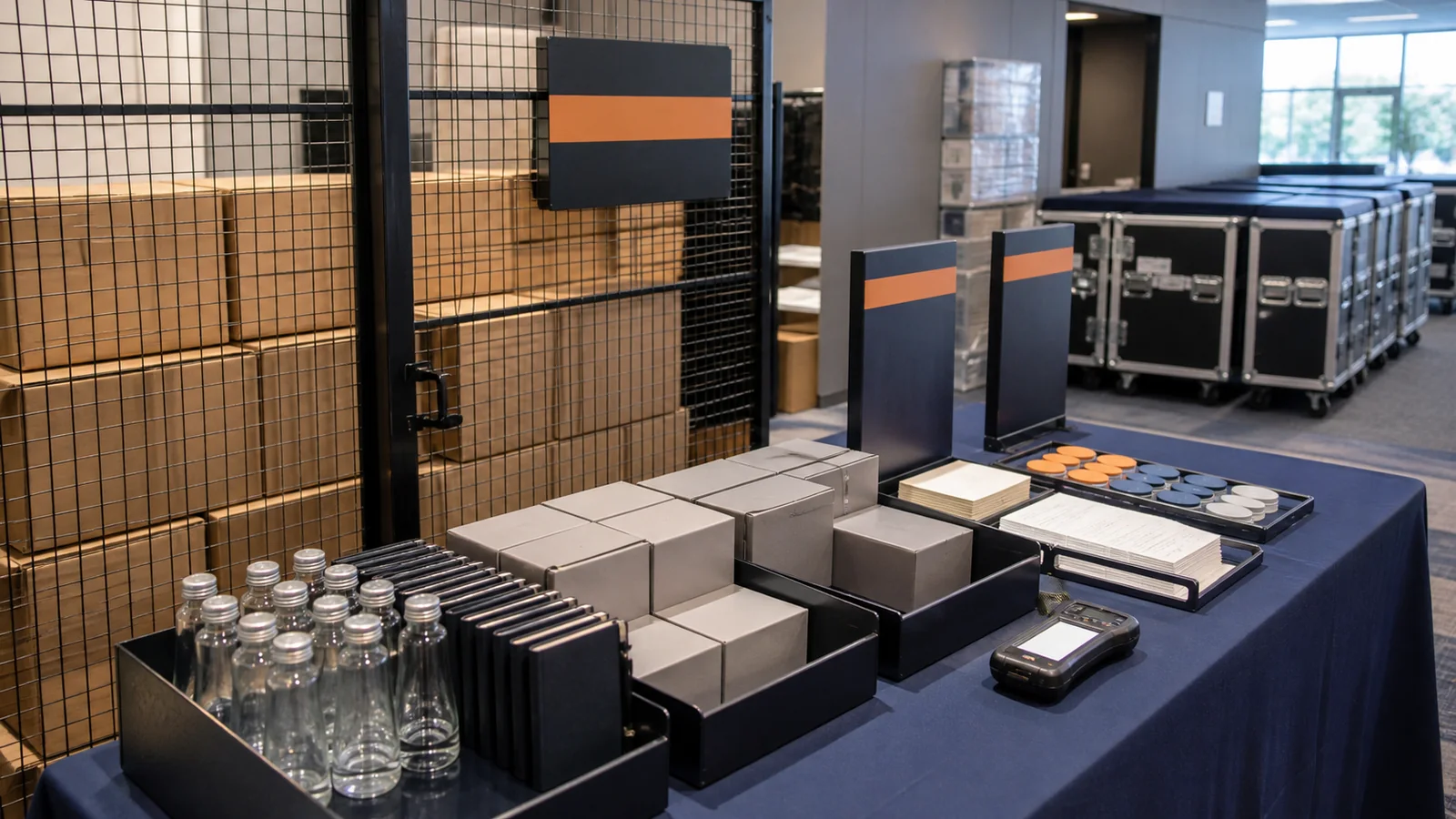
If general items move faster than expected, tighten the distribution condition before releasing the protected reserve. Do not take named-meeting sets to make the stand look full. The method for estimating and controlling each tier is covered in event merchandise quantity planning; the contingency rule is to preserve the next most important business outcome when a forecast proves wrong.
Use local incident codes
Keep event-morning reporting short enough that staff will use it. Codes such as damage, stock_variance, wrong_tier, venue_hold, recipient_change y security_issue can route an incident to the correct owner. Each code needs an allowed action and a time for escalation.
For example, a damaged visitor item may be quarantined and replaced from general reserve. A recipient change for a named gift may require approval from the account owner. A venue hold may require the logistics lead to produce delivery records. Staff should not improvise high-value reallocations or remove suspect products because a queue is forming.
At the end of each day, reconcile opening stock, released cartons, recorded distributions, damage and remaining reserve. Adjust the next morning’s release; do not rewrite the original forecast to make the numbers appear accurate.
Build the runbook before the incident
One page can hold the essential event merchandise contingency plan. For every credible failure, record:
- the trigger and latest decision time;
- the business outcome and quantity to protect;
- the stock or evidence needed to decide;
- the approved recovery ladder;
- the cost or authority ceiling;
- the decision owner and backup;
- the operational hand-off after approval;
- the communication needed for event staff and stakeholders;
- the evidence that closes the incident.
Run a short tabletop test with procurement, marketing, logistics and the on-site lead. Ask what they would do if inspection failed at T-21, half the first wave remained at customs at T-7, and the venue could not find six cartons on event morning. If two people give incompatible answers, the runbook is not finished.
The minimum viable recovery is not “some merchandise arrives”. It is a defined quantity, for a defined audience, in a usable condition, with the next action still possible. LUGVO corporate gifting services can coordinate products, samples, packaging and delivery around fixed event dates. Share the audience tiers, quantities, artwork status, venue details and contingency boundaries through the LUGVO services page to request a quote with recovery branches built in.



 English
  Español
  Français
  العربية
  Italiano
  Deutsch
  日本語
日本語  Nederlands
  Svenska
  Norsk bokmål
  Dansk
Dansk  Suomi
Suomi  한국어
한국어  Ελληνικά
  עִבְרִית
  Română
  Türkçe
  Русский