
An employee onboarding gift box should earn its place at four moments: before the start date, on day one, during the first week and by the end of the first month. That test is more useful than a long product checklist. Choose a compact core of items that helps the new hire feel expected, equipped and connected, then add local modules only where climate, working pattern, language or policy requires them. Remove anything with no clear use, uncertain sizing or difficult international delivery. The result may contain fewer products, but each one has a job and the programme is easier to replenish consistently.
Run the unboxing before you order
Place a sample box on a table and ask someone who did not create it to open it. Do they know what to read first? Can they identify which items are useful now and which can wait? Is the manager’s welcome visible, or buried beneath merchandise? Does the packaging feel proportionate to the contents?
This rehearsal exposes problems that a spreadsheet does not. A bottle may press against a notebook spiral. A garment may dominate the box even though its size is uncertain. A glossy insert may look polished but say nothing specific about the employee’s first day. A tightly fitted tray may protect the products yet prevent a local team from replacing one component.
The purpose of an onboarding box is not to prove that the company can fill a carton. It should support the employee’s entry into a real working environment. ISO 30405:2023 addresses recruitment guidance including planning, stakeholder management and candidate experience. It is not a gift-box standard; its relevance is the operating principle that the experience and the people responsible for it should be designed deliberately.
Build for four onboarding moments
Imagine the employee using the contents over 30 days rather than seeing them once in a product photograph.
Before the start date: The box confirms that the organisation is ready. A concise welcome message, practical date information and one recognisable brand item can do more than six unexplained products. If the package arrives early, avoid including confidential access details or equipment that should remain under IT control.
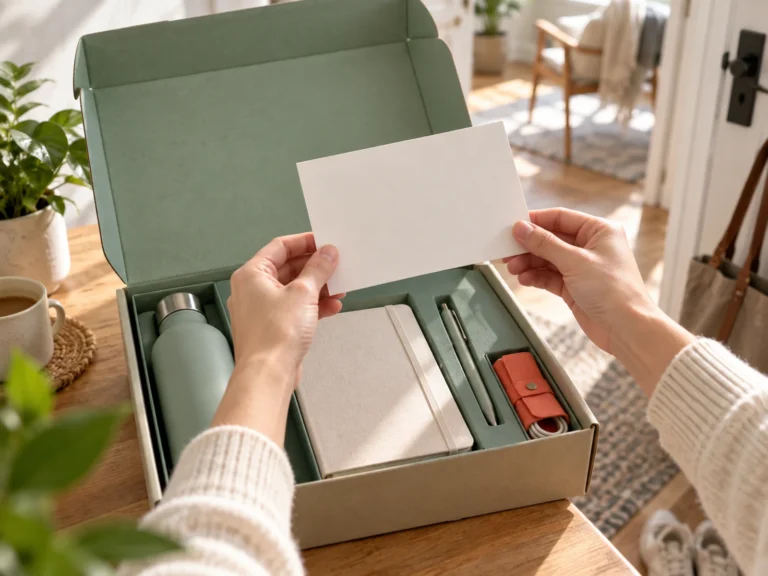
Day one: The employee needs orientation. A clearly ordered card can direct them to the manager, timetable or internal onboarding resource. A notebook, simple writing tool or other immediately useful item can support the first conversations. The gift should not compete with essential employment information.
First week: Items begin to prove whether they suit the working pattern. A travel mug may be valuable for a commuting role and irrelevant for someone who works entirely from home. A cable organiser may help a mobile team but add no value where devices remain at a fixed workstation.
First month: The best items have entered normal use. The rest become evidence. Ask a small, repeatable set of questions: what was used, what was confusing, what was unsuitable and what would the employee have preferred to omit?

This time sequence keeps the box connected to onboarding rather than turning it into a general employee appreciation pack. Appreciation has a different moment and message. Onboarding should reduce uncertainty and create a clear first connection.
Use a core kit with local modules
A global programme does not need one rigid box or a different box for every office. Use a controlled core plus a small number of approved modules.
| Layer | Typical contents | What stays controlled | What can vary |
|---|---|---|---|
| Global core | Welcome card, notebook, durable everyday item | Brand, quality, purpose and approval | Language version and legally required information |
| Working-pattern module | Desk, travel or remote-work item | Approved product families | Office, hybrid or remote role |
| Climate module | Light textile, insulated item or no addition | Material and brand standard | Destination season and practical need |
| Local fulfilment module | Protective packaging and carrier documents | Presentation sequence and quality check | Carton, carrier and destination paperwork |
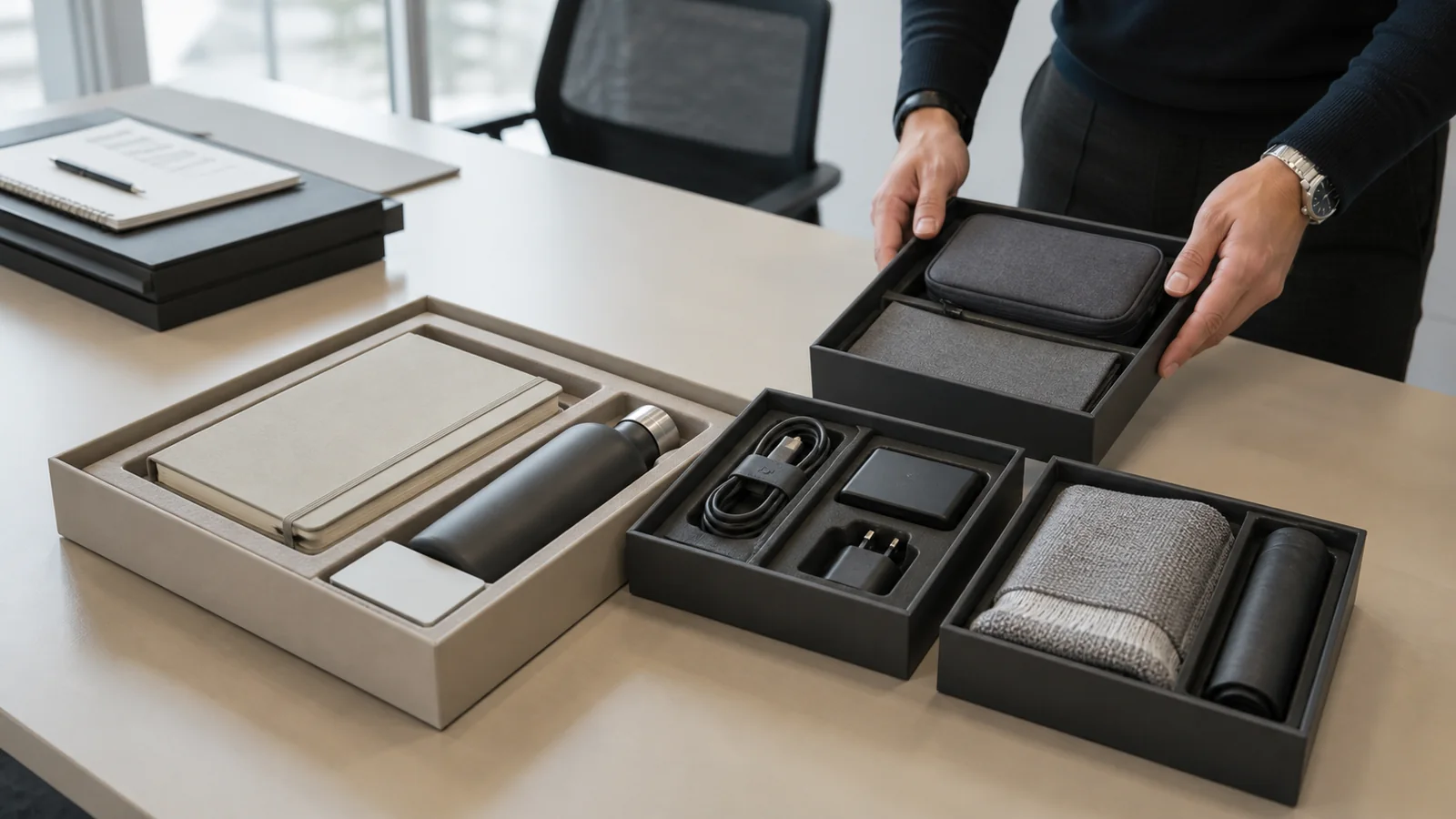
The core should be strong enough to feel complete on its own. A module is not a place to add random local merchandise. Give every permitted variation an owner, a substitution rule and an approved visual standard. Otherwise, “local flexibility” gradually becomes several unrelated programmes with different quality and cost.
The same discipline applies to decoration. A mark that works on a notebook may not reproduce well on a textile or curved bottle. Compare practical branding and decoration methods before applying one technique across dissimilar surfaces.
Test every component
For each proposed item, complete one sentence: “This belongs in the onboarding box because the employee will use or understand it when ___.” If the blank cannot be filled precisely, pause the item.
Then score it against five realities:
- Use: Does it support a likely behaviour in the first 30 days?
- Fit: Does it avoid unnecessary size, taste, dietary or cultural assumptions?
- Delivery: Can it travel to the required markets without disproportionate freight, breakage or customs complexity?
- Continuity: Can procurement replenish it or use an approved substitute without rebuilding the whole box?
- Evidence: Can HR learn whether it worked through a simple new-hire question?
Products do not have to be universal to pass. They need a defined audience. A sized garment can be appropriate when size is collected lawfully, exchanges are manageable and the employee genuinely wants it. It is a weak default when the programme simply guesses.
Inclusion also requires more than neutral-looking packaging. ISO 30415:2021 provides human-resource diversity and inclusion guidance; it does not prescribe welcome gifts. Applied carefully, the relevant editorial lesson is to examine barriers and assumptions throughout the process. Avoid gendered selections without a role-based reason, religious or dietary assumptions, inaccessible instructions and products that only suit one office culture.
Plan the operational hand-offs
An excellent sample can still produce a poor onboarding experience if the hand-offs fail. HR owns the hire date and employee communication. The manager owns the human welcome. Procurement owns the approved specification and supplier terms. The fulfilment partner owns pick, pack and dispatch controls. Someone must own exceptions.
Map the trigger backwards from the intended arrival date. Decide when the order becomes eligible, which address fields are necessary, when data is transferred, how failed deliveries are handled and when personal data is removed. Address collection deserves its own controlled process; the employee gift address privacy guide covers that data flow in detail. Do not duplicate sensitive addresses in informal trackers merely because the gift programme is friendly in tone.
Also define the substitution boundary. If one bottle colour is unavailable, can the supplier use another approved colour? If the notebook changes, must paper, dimensions and decoration position remain within a range? If the exact box is delayed, can the protective packaging change without altering the opening sequence? Pre-approved rules are faster and safer than emergency decisions made after a start date is fixed.
Walk through a 24-person intake
A representative technology company plans an October intake of 24 employees across Germany, France, the Netherlands, Ireland and Spain. Fourteen are hybrid, eight are office-based and two work remotely. The initial concept contains a hoodie, bottle, notebook, snack selection, cable kit and a fully custom box.
The 30-day test changes the design. HR removes the snacks because the dietary and local-labelling work is disproportionate for this intake. The hoodie becomes an opt-in item fulfilled later, preventing the welcome box from being delayed by missing sizes. The core box keeps a notebook, an approved bottle and a manager-signed welcome card. A compact cable organiser is added only for the hybrid and remote roles.
The team uses one presentation sequence but permits destination-appropriate protective cartons. It sets an order trigger ten working days before the start date and a documented late-hire route. The programme now has fewer objects, yet every employee receives a complete core experience and the operations team can explain every variation.
The box also links to the broader choice of מתנות עם לוגו החברה לעובדים, but it does not try to solve every recognition moment at once. Work anniversaries, project awards and seasonal appreciation should have their own purpose and timing.
Make the 30-day decision
After each intake, review the programme as an operating system. Compare promised and actual arrival, damage and replacement rates, component use, employee comments, local exceptions and unused inventory. Keep the questions short enough to repeat. A detailed annual survey is less helpful than consistent evidence after every cohort.
Give each component one outcome: retain, revise, move to an optional module or remove. If employees value the welcome card but ignore the expensive accessory, protect the message and change the product. If one market needs a different delivery route, alter fulfilment rather than redesigning the entire box. If managers do not personalise the welcome, solve the ownership problem before adding merchandise.
An employee onboarding gift box checklist should therefore end with a test, not a shopping total: will this component help at a named moment within 30 days, and can the organisation deliver it reliably to the intended employee? LUGVO branded merchandise solutions can support a controlled core-and-module programme, and the LUGVO services page outlines sourcing, customisation, packaging and international delivery support for a defined brief.



 English
  Español
  Français
  العربية
  Italiano
  Deutsch
  日本語
日本語  Nederlands
  Svenska
  Norsk bokmål
  Dansk
Dansk  Suomi
Suomi  한국어
한국어  Ελληνικά
  עִבְרִית
  Română
  Türkçe
  Русский