
Corporate gift packaging cost is not the box price. A useful budget includes the structural pack, insert, decoration, tooling, assembly, protective shipping materials, freight, duties or taxes where applicable, inspection and the cost of failures. Buyers should compare suppliers on landed packaging cost per usable gift, using the same specification and exclusions for every quote.
The largest cost is not always the most visible component. A deep rigid box may look reasonably priced at the factory yet increase insert material, carton volume, assembly time and international freight. A simpler folding carton can cost more per unit in one line item but lower the total programme cost. The right choice protects the products, supports the intended recipient experience and survives delivery without paying for structure that adds no practical value.
Use landed packaging cost, not the quoted box price
Build the budget in layers:
Landed packaging cost = structural packaging + insert + decoration + tooling and set-up + assembly + protective transit packaging + inspection + freight + import charges + expected failure cost.
Divide one-off charges by the number of usable packs, not the ordered quantity. If 500 boxes are ordered but quality loss and transit damage leave only 480 usable, the real unit cost is total spend divided by 480.
Ask each supplier to show what is included. “Custom gift box: USD 8.50” is not comparable with “assembled presentation pack: USD 11.20” until you know whether both include the insert, printing, magnetic closure, tissue, gift card placement, outer mailer and assembly.
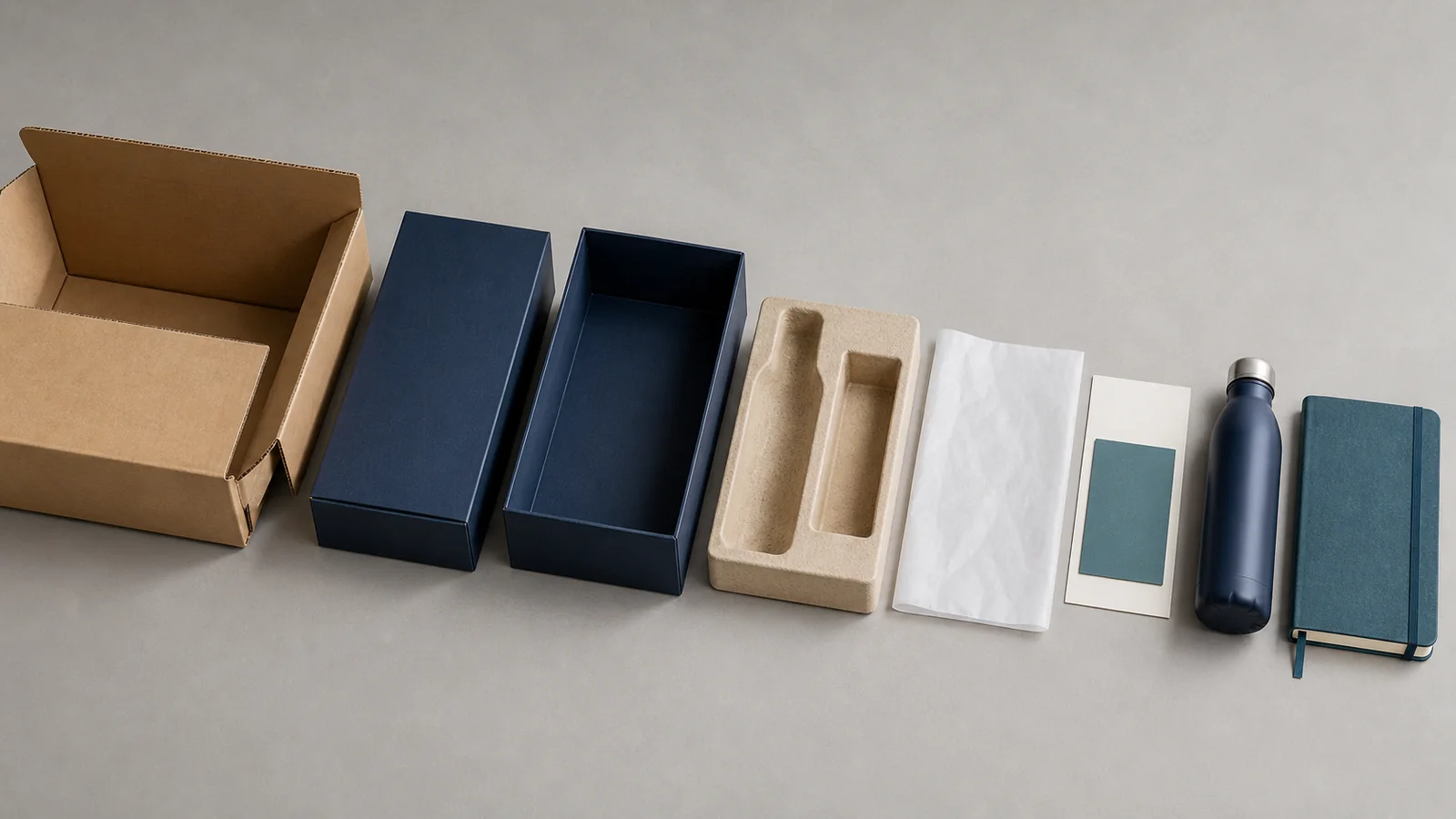
Nine corporate gift packaging cost factors
1. Structure and opening experience
Folding cartons, corrugated mailers, lift-off rigid boxes, book-style magnetic boxes, sleeves and reusable cases use different amounts of material and labour. Rigid boxes are normally supplied formed, so they occupy more shipping space. Flat-packed formats can reduce volume but may move assembly work to another facility.
Choose the structure after defining the distribution method. A presentation box handed to an executive at a dinner faces different risks from a gift sent through an international parcel network. The second may need a protective mailer, void fill and a stronger closure even if the recipient-facing box looks identical.
2. Dimensions and empty space
A few unnecessary centimetres can affect board consumption, insert size, master-carton count and dimensional freight weight. The design should follow the product arrangement, not an arbitrary “premium” box size.
Request an internal layout showing the largest tolerance for every product. If drinkware, electronics or food containers come from separate suppliers, allow for production variation. Reducing empty space is useful only if the tighter pack still accommodates real samples and protects surfaces during transport.
3. Material and finish
Board grade, paper wrap, corrugated flute, moulded pulp, foam, fabric and plastic trays have different purchase, converting and disposal implications. Finishes such as soft-touch lamination, textured paper, foil stamping, spot varnish and debossing add process steps, set-up waste and inspection points.
Premium does not require every finish. One well-controlled paper, a precise colour and a single tactile detail can look more deliberate than a pack carrying foil, lamination, ribbon and multiple print techniques at once.
4. Inserts and product retention
The insert often determines whether the pack works. It positions products, protects decorated surfaces and keeps the arrangement intact after courier handling. Cost depends on material, number of cavities, cutting complexity, depth, hand-finishing and whether components need separate sleeves or bags.
Prototype the insert with production-equivalent items. A drawing based only on nominal dimensions can fail when bottle lids, cable bundles or fabric products vary in shape.
Before production release, use a corporate gift sample approval checklist to document the approved insert, product fit and artwork.
5. Decoration and colour control
Printing method depends on material, quantity, artwork and colour tolerance. Digital printing can suit some smaller runs; offset or screen processes may be economical at different volumes; foil and embossing require dedicated tooling.
Brand-colour approval also has a cost. A buyer who requires a physical colour proof, material swatches and multiple press checks should budget for them. That control may be justified for a global launch, while a one-colour mark on a neutral sleeve may be adequate for an internal event.
6. Tooling, samples and set-up
Dielines, cutting dies, foil blocks, embossing plates, print screens, moulded-insert tools and machine set-up are usually one-off or batch-level charges. They have a large effect at low quantities and a smaller per-unit effect as volume rises.
Confirm who owns the tooling, how long it will be retained and whether a repeat order can reuse it. A cheap first run is less attractive if the supplier charges the full tooling amount again without explanation.
7. Assembly and kitting
Packaging price may exclude forming boxes, inserting products, removing protective films, applying labels, adding cards, checking personalisation and sealing the final shipper. These are labour tasks with measurable cycle times.
Complex kits also create line-balance problems. If one item arrives late, completed packaging may occupy storage while the assembly team waits. A clear bill of materials and inbound deadline for every component reduces that risk.

8. Transit protection and delivery format
The recipient pack and the transport pack serve different jobs. Parcel delivery may require an outer corrugated mailer, corner protection, moisture protection and tamper control. Pallet delivery to an event can use master cartons and controlled handling instead.
Test the intended route. Adding protection after damage appears is more expensive than designing it into the pack, but excessive protective material also increases cost and waste. The goal is the minimum system that passes the agreed handling test and arrives presentable.
9. Freight, import and storage
Packaging can be light but volumetric. Compare master-carton dimensions, pieces per carton, gross weight and pallet configuration. Ask for these figures before approving the structure, not after production.
For international programmes, identify the agreed Incoterm, importer, duty basis, destination charges and tax treatment. Also price temporary storage and split deliveries. A factory unit price cannot reveal the full effect of sending 500 formed rigid boxes by air.
A representative 500-kit quote comparison
Consider a procurement team preparing 500 employee welcome kits for delivery to one European distribution point. The figures below are illustrative in USD and exclude the gift products, taxes and duties. They show how to normalise quotes, not typical market prices.
| Cost component | Supplier A | Supplier B |
|---|---|---|
| Recipient-facing box | USD 7.20 | USD 9.40 |
| Insert and decoration | USD 2.95 | Included |
| Tooling and samples | USD 480 total | USD 250 total |
| Assembly | USD 1.25 | Included |
| Protective shipper | USD 0.80 | USD 1.10 |
| Freight to distribution point | USD 3,200 total | USD 2,300 total |
Supplier A appears cheaper if the buyer compares only USD 7.20 with USD 9.40. Normalised across 500 kits, however:
- Supplier A: 7.20 + 2.95 + 0.96 tooling + 1.25 + 0.80 + 6.40 freight = USD 19.56 per kit.
- Supplier B: 9.40 + 0.50 tooling + 1.10 + 4.60 freight = USD 15.60 per kit.
The lower freight may result from a more compact folding structure rather than a better carrier rate. The procurement team must still compare material quality, product protection, approved sample, damage assumptions, lead time and commercial terms. The exercise demonstrates why line-price comparisons are unreliable.
Add expected failure cost
Damage, missing components and rework should not be hidden under “contingency”. Estimate them explicitly:
Expected failure cost per pack = estimated failure rate × average correction cost.
If a programme expects 2% of 500 packs to need correction and each correction costs USD 28 in replacement, handling and reshipment, the expected programme exposure is USD 280, or USD 0.56 per ordered pack. That does not mean accepting a 2% defect rate. It gives finance a consistent way to compare a proven packaging system with an untested cheaper one.
Define what counts as a failure: crushed corners, product movement, scuffed decoration, missing cards, wrong personalisation or a parcel that cannot be delivered. Use the same definition when reviewing samples and production inspection.
Account for current EU packaging requirements
For programmes placed on the EU market, packaging decisions now need a current regulatory responsibility check. The European Commission states that the Packaging and Packaging Waste Regulation generally applies from 12 August 2026. Its packaging overview describes requirements covering the packaging life cycle and notes that the rules apply to packaging placed on the EU market, regardless of material or origin. Some measures have later phase-in dates, so a buyer should not treat one generic statement as proof that a pack is compliant in every case.
Ask the responsible compliance team or qualified adviser to confirm the product-market scenario, packaging category, economic-operator responsibilities, required documentation and applicable dates. The European Commission’s packaging waste page is a sensible primary starting point, but it is not a substitute for product-specific legal review.
Commercially, this check can affect material declarations, supplier documentation, labelling decisions, design choices and record keeping. Add those tasks to the quote rather than discovering them after artwork approval.
Reduce cost without making the gift feel cheaper
Cost reduction works best in this order:
- Remove avoidable volume. Tighten the layout around approved product samples.
- Simplify hidden structure. Use protection where it performs a job; remove decorative layers the recipient will not notice.
- Limit decoration processes. Keep one strong brand detail instead of stacking finishes.
- Move variable information to a sleeve or card. This can preserve reusable core packaging for other markets or campaigns.
- Standardise components. A common box size across several kits may improve purchasing and storage even if each insert differs.
- Separate presentation from transit protection. Optimise each layer for its actual job.
- Compare sea, rail, road and air options against the required date. Do not force the cheapest production choice into an expensive emergency shipment.
The guides to custom gift boxes and wrapping and the broader custom business gift process provide useful context for presentation, sampling and quality control. Buyers planning product and packaging together may also find the overview of customised gifts and logo gift boxes helpful.
Send a packaging RFQ suppliers can price properly
Include the following in the request for quotation:
- pack quantity and acceptable overrun or underrun;
- destination countries and delivery format;
- product dimensions, weights and production tolerances;
- required opening experience and product arrangement;
- preferred and prohibited materials;
- artwork, colour standard and decoration method;
- insert and surface-protection requirements;
- sample stages and approval owners;
- assembly bill of materials;
- transit-test expectation and acceptable quality limits;
- master-carton and pallet data;
- tooling ownership and repeat-order terms;
- Incoterm, freight mode and quoted exclusions;
- compliance evidence and market-specific responsibilities.
Ask suppliers to return a cost breakdown and a completed exclusions table. A transparent quote makes design trade-offs possible before money is locked into tooling.
LUGVO branded merchandise solutions can help translate a product list, brand brief and delivery plan into a packaging specification. To compare structures and request a quote, send the quantity, product dimensions, destination, target date and presentation priorities through the LUGVO services page.


 English
  Español
  Français
  العربية
  Italiano
  Deutsch
  日本語
日本語  Nederlands
  Svenska
  Norsk bokmål
  Dansk
Dansk  Suomi
Suomi  한국어
한국어  Ελληνικά
  עִבְרִית
  Română
  Türkçe
  Русский