There is no single best way to put a logo on branded merchandise. Choose the decoration method after confirming the product material, surface, artwork, expected wear, quantity and required finish. Screen printing suits repeatable solid-colour graphics; embroidery creates a dimensional textile mark; direct-to-film transfer handles detailed multicolour apparel artwork; dye sublimation works with suitable polyester and coated surfaces; pad printing reaches small or curved items; and laser engraving permanently changes a compatible surface without adding ink.
The buyer’s task is not to ask which process sounds most premium. It is to match the process to the substrate and use case, then approve a physical result that can be reproduced. A polished digital mock-up cannot show hand-feel, ink opacity, stitch density, engraving contrast or how the decorated item behaves after washing and handling.
Start with the product, not the artwork
Request the product’s exact material and surface finish. “Metal bottle” is insufficient: coated stainless steel, bare stainless steel and anodised aluminium can react differently to the same laser. “Polyester shirt” does not state fibre percentage, colour, stretch, coating or whether dye migration is likely. “Cotton bag” does not reveal weave, seams or the flat area available to print.
Then define six inputs:
- Substrate: material, colour, coating, texture and construction.
- Artwork: colours, gradients, fine lines, small text and required colour match.
- Utilizzo: washing, abrasion, sunlight, food contact, outdoor exposure or frequent handling.
- Quantità: total run, colour variants, individual names and likely reorders.
- Experience: visual finish, hand-feel, weight, flexibility and brand position.
- Schedule: sample rounds, setup, production, curing, inspection and replacement capacity.
Eliminate processes that are incompatible before comparing price. A low quote for the wrong process becomes expensive once the logo cracks, a bottle coating burns unpredictably or a dense embroidered mark distorts a lightweight garment.
Decoration method comparison
| Method | Strong fit | Watch-outs | Evidence to approve |
|---|---|---|---|
| Screen printing | Solid-colour graphics on flat textiles and some suitable products; efficient repeat runs | Setup per colour, seams, ink opacity, curing, hand-feel and registration | Production-method sample, colour under relevant light, wash or rub test |
| Embroidery | Polos, caps, jackets, bags and heavier textiles where a dimensional mark suits the product | Small text, fine gradients, puckering, backing, stitch count and wearer comfort | Sew-out on the actual fabric, digitised artwork, reverse-side finish |
| DTF or transfer | Detailed, multicolour or short-run apparel across varied compatible fabrics | Transfer feel, edge, stretch, adhesion, heat sensitivity and dye migration | Actual transfer on the final garment, wash and stretch test |
| Dye sublimation | Polyester performance apparel and compatible coated products; all-over or photographic colour | Requires a suitable polyester or coated substrate; colour and heat behaviour vary | Material-confirmed sample, colour reference and wash/use test |
| Pad printing | Small logos on curved or irregular promotional items | Limited print area, colour registration, opacity, surface energy and adhesion | Decorated production sample plus rub or adhesion test |
| Incisione laser | Compatible metal, wood, glass, leather-like and coated surfaces; permanent mark with no ink layer | Contrast depends on material and coating; heat can mark or deform unsuitable items | Engraved sample from the same material and finish batch |
The table is a selection aid, not a production specification. Equipment, ink, thread, pretreatment, temperature, pressure, dwell time and operator control affect the result. Ask the supplier to name the proposed process and key controls rather than accepting “printed logo” as the full description.
When screen printing is the practical choice
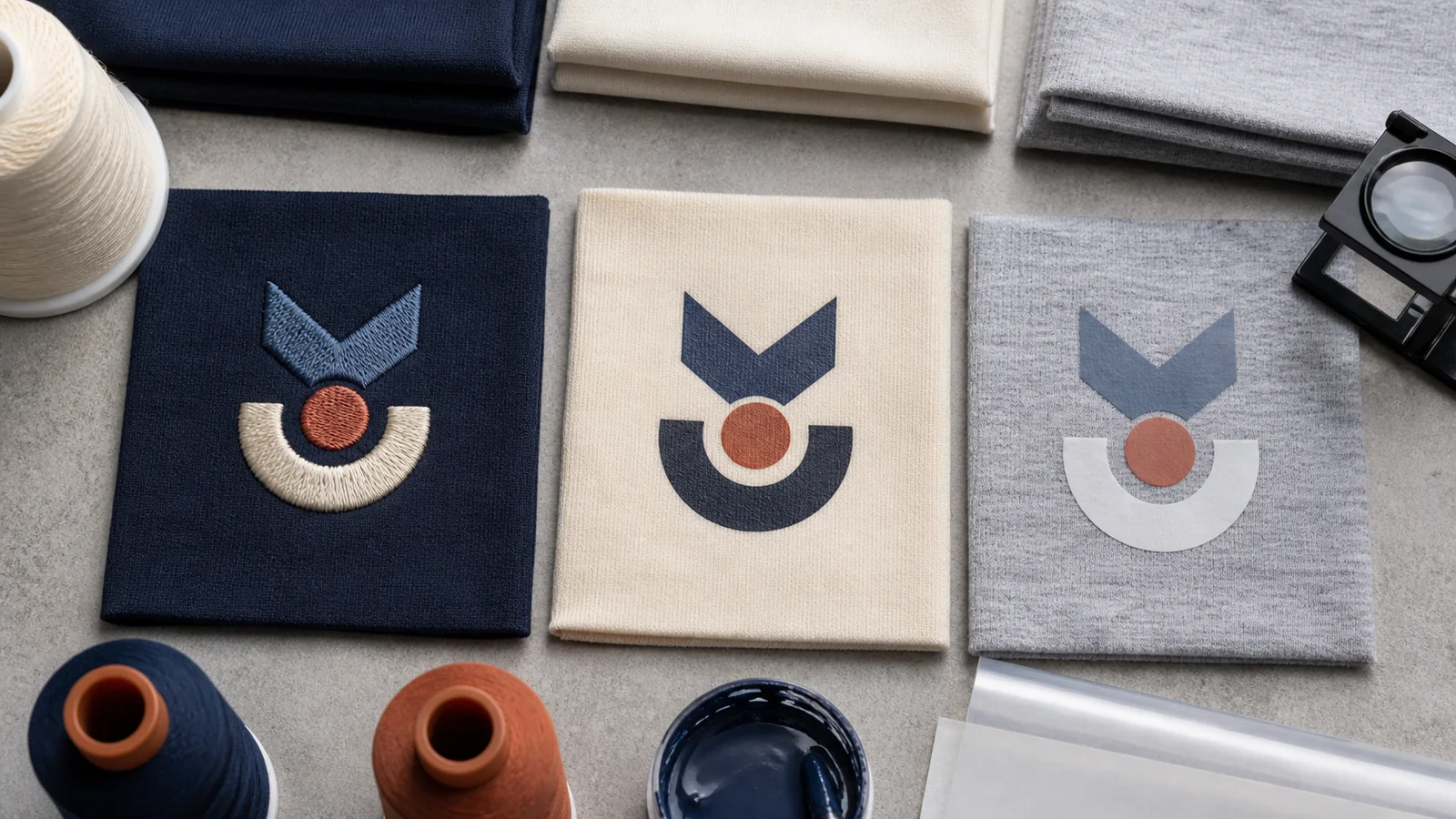
Screen printing pushes ink through a prepared screen, normally with a separate setup for each colour. It is a strong candidate for clear, solid artwork repeated across a meaningful run. It can produce good opacity and a durable result when the ink system, pretreatment where required and curing conditions suit the material.
It becomes less attractive when artwork changes by recipient, contains many gradients or crosses seams and pockets. The number of colours can affect setup and registration work. Ask whether the quoted price assumes one ink colour, one print location and one product colour; a five-colour front graphic plus a second location is a different job.
Approve the actual ink and substrate combination. Check fine lines, colour coverage on dark material, edge definition, registration, tackiness, cracking and fabric feel. A wash test should use the care method that recipients are likely to follow, not an easier internal cycle chosen only to obtain a pass.
When embroidery earns its place
Embroidery uses thread and stitch structure, giving depth that can suit uniforms, caps, premium outerwear and durable bags. It handles frequent wear well when the garment, backing and stitch design work together. It also separates the mark from print trends: thread texture is part of the result.
The logo must be digitised for embroidery. Tiny lettering, thin negative spaces and complex tonal gradients may need to be simplified. A dense design can make a lightweight shirt stiff or cause puckering. Cap construction can constrain placement and stitching direction.
Request a sew-out on the actual product or the same fabric construction. Inspect it from normal viewing distance and close up. Check letter openings, thread colour, loose ends, backing, distortion and how the reverse side feels against the wearer. The approved sew-out and digitised file should be version controlled.
When DTF or another heat transfer helps
Direct-to-film printing creates a printed transfer that is applied to a garment with heat and pressure. It is useful for detailed colour, shorter runs and artwork that would require many screen-print setups. A current Roland DG apparel guide describes DTF as applicable across cotton, polyester, blends and dark materials on compatible systems. That is manufacturer guidance, not proof that every transfer works on every garment.
Test the final combination. Heat can mark sensitive fabric, and adhesion depends on ink, film, powder, press settings and surface. Evaluate the print edge, white underbase, flexibility, stretch, wash resistance and the feel of a large transfer in a breathable area. Do not infer durability from one supplier’s machine claim when another factory uses a different system.
Heat-transfer vinyl is another route for simple names, numbers and special finishes. It can be efficient for variable data, but layering, material thickness and cut detail need approval.
When dye sublimation fits the substrate
Dye sublimation uses heat to move dye into a compatible material rather than leaving a conventional ink layer on top. It can give vivid, detailed colour and a light hand-feel on suitable polyester textiles, including performance garments. The current Roland DG dye-sublimation guide notes that transfer applications generally require polyester content and that direct textile processes may need pretreated fabric and heat fixation. Exact requirements depend on the system.
It is not a universal method for natural-fibre garments. On coated drinkware or hard goods, the coating—not merely the base object—makes sublimation possible. Confirm white points, colour shift, show-through on stretched fabric, transfer marks and consistency across panels. If an all-over design is cut and sewn after printing, align important graphics away from uncertain seams.
When pad print or laser suits hard goods
Pad printing transfers ink with a flexible pad, which can reach small curved or recessed areas. It is common on pens, cases, small devices and other promotional products where the printable area is limited. Artwork should respect the actual pad area, curvature and registration tolerance. Adhesion testing matters because a visually correct logo can rub off an incompatible coating.
Laser engraving removes or changes a surface layer. It can produce a precise, permanent mark on compatible goods without an added ink colour. The resulting colour is determined by the material beneath the coating or by the material’s laser response; it may not match a brand colour. Epilog’s promotional-product laser overview shows a wide range of proposed materials, but a supplier still needs to confirm that the exact product is suitable and that engraving will not compromise function or a protective finish.
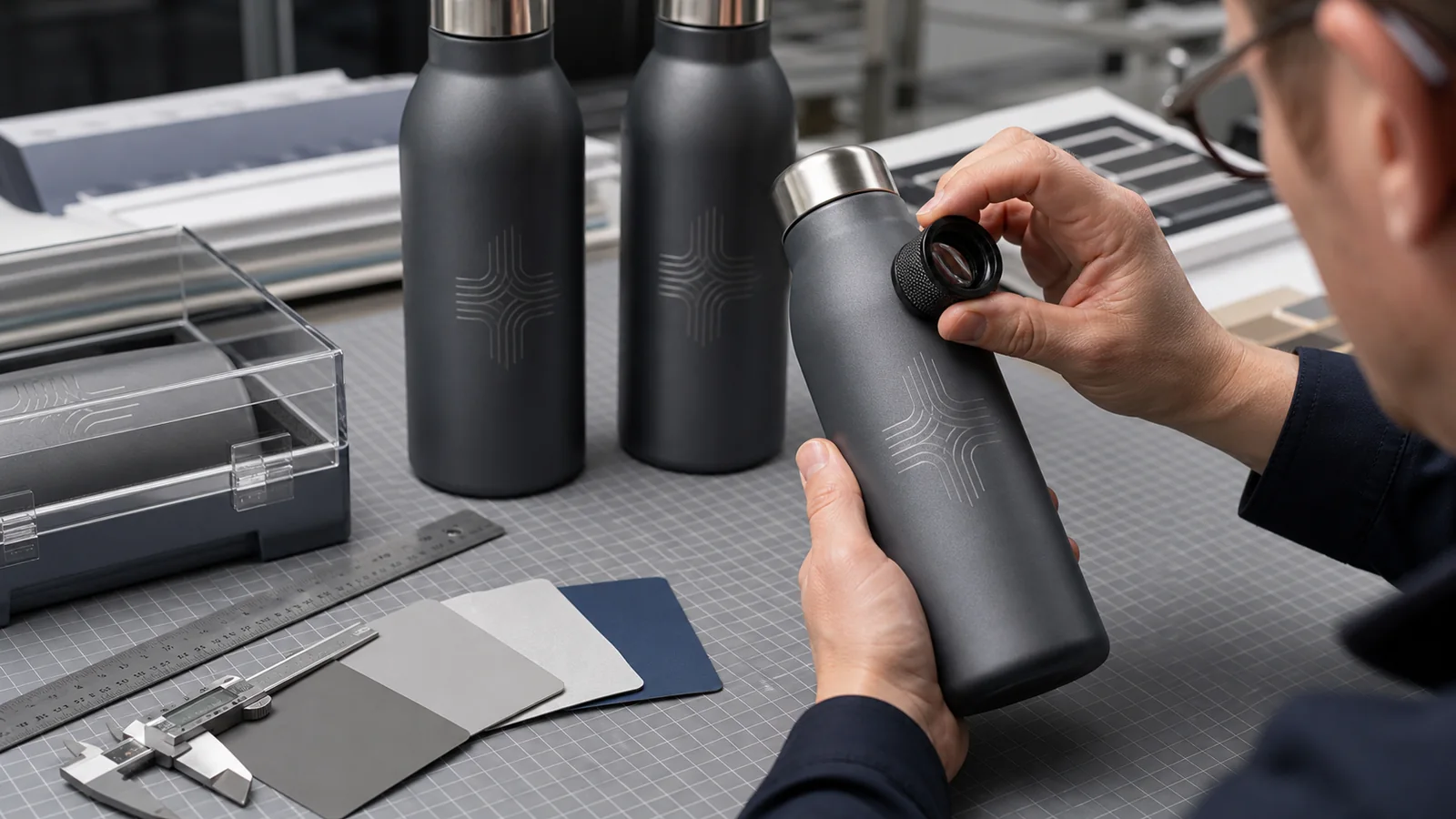
For drinkware, check the engraving position with the lid, handle and normal grip considered. For wood, expect natural tone and grain variation. For coated metal, approve the exposed contrast and inspect edges for residue or uneven removal.
Adapt the artwork to the process
One master logo file can produce several process-ready files. Record the approved artwork version, colour references and transformation rules:
- minimum text and line size;
- permitted simplification for embroidery;
- solid-colour separation for screen or pad print;
- white underbase and transparency handling for transfers;
- colour profile and substrate white point for sublimation;
- vector paths and fill behaviour for engraving;
- placement measured from physical product landmarks;
- maximum permitted position and scale tolerance.
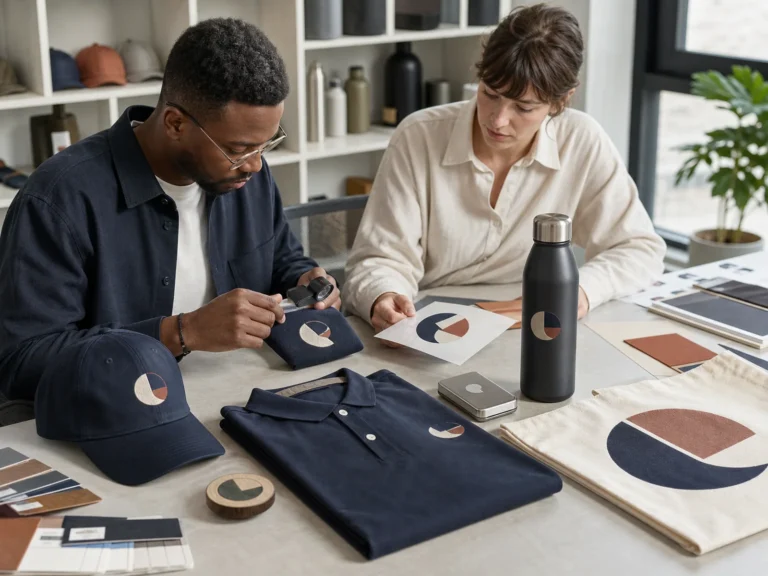
Do not approve artwork only on a page template. Photograph or scan the physical sample beside a ruler and a colour reference where practical. Keep the sample or an agreed golden reference for production inspection.
The broader guide to branded merchandise people keep can help select the item before decoration. Popular swag items versus unique company swag helps test whether novelty supports the use case. For more complex development, the custom business gifts process explains how product, packaging and approvals connect.
Timely example: performance apparel for a September activity
The European Commission lists the 2026 European Week of Sport for 23–30 September. Consider a representative employer ordering 600 shirts for staff activities in four European offices. The garments are lightweight polyester, the design uses a gradient and three shirt colours, and employees will exercise in them.
The team excludes dense embroidery because it would create a stiff, heavy area. It compares sublimation and DTF on the actual shirts. Sublimation gives a lighter feel on one suitable light-coloured garment, while DTF makes the artwork visible across the darker variants. Rather than force one process, procurement permits two production routes with a common artwork scale and viewing standard. Samples are washed and stretched before approval.
The employer uses its own approved design. It does not copy the event identity or partner logos without the necessary permission. The example shows the selection logic; it does not claim that either process is always superior for sportswear.
Ask for a process-specific quote
Provide the product code and material, quantity by colour and size, artwork files, number of locations, colour references, required finish, use conditions, target date and destination. Ask the supplier to state the process, setup assumptions, sample type, production tolerances, test method and what changes if the product batch or coating changes.
Send LUGVO the intended product, artwork, quantity, use conditions and required-in-hand date for a process recommendation and sample plan. The LUGVO services page covers product sourcing, customisation, sampling, production, packaging and international delivery. The right decoration method is the one that can be approved on the real material, produced consistently and still look appropriate after the merchandise has been used.



 English
  Español
  Français
  العربية
  Italiano
  Deutsch
  日本語
日本語  Nederlands
  Svenska
  Norsk bokmål
  Dansk
Dansk  Suomi
Suomi  한국어
한국어  Ελληνικά
  עִבְרִית
  Română
  Türkçe
  Русский