
A corporate gift follow-up plan for sales teams should not begin with “Did you like the gift?” It should begin with a verified delivery state and a reason to contact the recipient. Logistics recovery, human courtesy and a commercial conversation are three different jobs. Give each job an owner, timing rule and stop condition before the gifts leave fulfilment. That prevents awkward chasing, missed delivery problems and activity that cannot be explained in the CRM.
The practical objective is modest: confirm that the intended recipient received the right item, resolve exceptions quickly, and let the account owner continue a relevant business conversation only when the relationship and communication rules support it. A gift is context, not consent and not a debt.
Separate the three follow-up jobs
Many programmes fail after delivery because one generic task—“follow up”—is assigned to the salesperson. The task hides three distinct outcomes.
Delivery recovery determines whether the parcel arrived, whether it reached the correct person and whether damage, refusal or an address problem needs action. It belongs with fulfilment or programme operations. A carrier scan is evidence of movement, but it may not prove that the intended recipient has the gift in hand.
Courtesy acknowledgement is a brief, human message that confirms receipt where such contact is appropriate. It does not demand a reaction, product photograph, social post or meeting. The sender may be an executive sponsor, account owner or programme coordinator depending on the relationship.
Commercial follow-up reconnects the gift to an existing account objective: a planned review, event debrief, implementation milestone or relevant proposal. It should make sense if the gift is removed from the sentence. If the only reason for the email is to extract a response, the message is too weak.
Keep the records separate as well. Delivery status belongs in the fulfilment record. A courtesy note can be logged as an account interaction. A sales opportunity should change only when there is real commercial evidence, not because a parcel reached the building.
Set timing by delivery state
Do not schedule every recipient for the same follow-up day. Start the clock from the actual delivery state and the response needed.
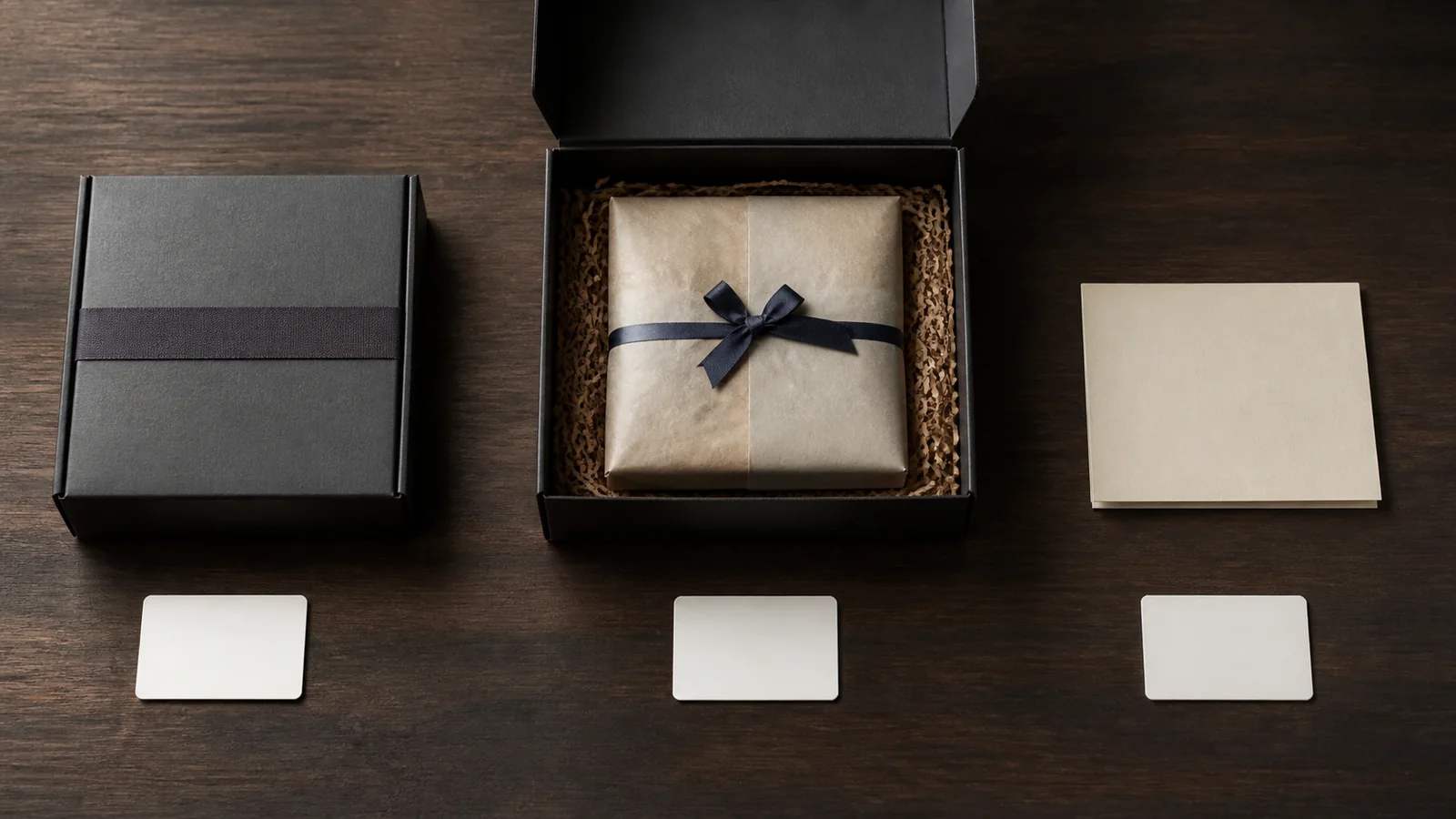
| Delivery state | First action | Owner | Commercial contact rule |
|---|---|---|---|
| Delivered to named recipient | Wait for the agreed courtesy window, usually one or two working days | Account owner or sponsor | Continue only with a relevant account reason |
| Delivered to reception or mailroom | Confirm internal hand-off if the relationship permits | Programme coordinator | Do not ask the recipient to praise an item they may not have seen |
| Address exception or failed attempt | Correct the record and coordinate redelivery | Fulfilment owner | Pause sales contact until the exception is resolved |
| Refused or returned | Establish whether the cause was policy, absence, address or preference | Programme owner | Do not resend automatically |
| Damaged, incomplete or incorrect | Apologise, collect only the evidence needed and offer a recovery choice | Fulfilment owner | Keep recovery separate from a sales request |
| Recipient opted out or account policy prohibits gifts | Record the restriction and close the gifting action | Compliance or account owner | No gift-based marketing follow-up |
A fixed “three emails in seven days” sequence ignores these states. It can create the absurd result of a salesperson asking about a gift while operations knows the carton is being returned.
Build the sequence backwards from the recipient experience. A delivery exception needs attention within hours or one working day. A courtesy message can wait long enough for internal mail to move. A business discussion may already be scheduled and need no extra touch at all.
Assign evidence and ownership before dispatch
Create one follow-up record for each recipient or account. It does not need dozens of fields. It does need enough evidence to stop teams working from different versions of the truth:
- programme and item identifier;
- recipient and account owner;
- approved communication route;
- delivery state and timestamp;
- policy or consent restriction;
- recovery case and owner, if any;
- courtesy contact due date and completion;
- next legitimate account interaction;
- stop reason and date.
Avoid copying sensitive delivery details into every sales note. The CRM can hold a reference to the controlled fulfilment record rather than a complete home address or carrier history. The earlier LUGVO guide to employee gift address collection explains why recipient data should be limited and separated by purpose; the same discipline is useful for client programmes.
The UK Information Commissioner’s Office explains that B2B marketing rules vary by contact method and type of business, and that the UK GDPR still applies when personal data is processed in a business context. Its current business-to-business marketing guidance also notes that business contacts can object to direct marketing. EU guidance similarly states that a person who objects to processing for direct marketing may no longer have their data used for that purpose; see the European Commission’s page on dealing with data-subject requests.
Those rules do not produce one global email script. Jurisdiction, contact type, channel, existing relationship and local policy matter. Ask the organisation’s privacy or legal owner to approve the follow-up route for the intended markets. Operationally, make an objection or opt-out a hard stop that propagates to the campaign list, not a note someone must remember to read.
Give each decision one owner
The fulfilment team owns parcel truth. The account owner owns relationship context. Marketing or programme operations owns the campaign design. Privacy, legal or compliance functions define restrictions where required. One person may perform several roles in a small programme, but the decision rights should remain visible.
Do not let a seniority rule override evidence. An executive recipient whose parcel is still at a carrier depot needs recovery, not an escalated sales message. A low-value account with a confirmed policy restriction needs closure, not a manager exception.
Handle non-response and exceptions without pressure
Silence is not a delivery failure and it is not an invitation to intensify contact. Decide in advance what will end the sequence.
A restrained stop rule might be:
- Resolve any delivery or item problem first.
- Send one appropriate courtesy message after confirmed receipt.
- If there is an already-planned business interaction, continue through that channel without making the gift the agenda.
- If there is no relevant next step, close the gift follow-up after the courtesy contact.
- If the contact objects, declines gifts or cites policy, record the restriction immediately and stop.
Do not measure success by thank-you replies alone. Senior contacts may acknowledge gifts through an assistant; remote staff may open parcels days later; a recipient may appreciate an item without responding. A reply rate can be useful operational evidence, but it is not proof of relationship value.
The earlier corporate gift campaign measurement framework separates delivery, engagement, relationship and commercial outcomes. Use it after the follow-up workflow is clean. Otherwise, repeated chasing can inflate activity while reducing trust.
Treat refusal as information
A return or refusal should create a reason code: address error, absence, customs cost, damaged parcel, no-gift policy, unwanted item or unknown. The code determines the next action. A corrected address may justify redelivery. A no-gift policy does not.
Agree what happens to returned stock. Generic products may enter controlled replacement inventory. Personalised items may need secure disposition. The corporate gift replacement stock guide provides a failure-mode method for reserve, rework and retirement decisions.
Run a worked account sequence

Consider a representative programme for 80 client contacts after a multi-city product launch. The team sends a useful, unbranded travel accessory with a discreet presentation sleeve. Delivery data shows 69 named deliveries, six reception deliveries, three address exceptions and two refusals.
Operations opens three address cases and holds them out of the sales queue. It asks the six account owners to confirm internal mailroom hand-off, but does not contact the recipients yet. The two refusals are checked against account policy; one is a temporary office closure, while the other company prohibits personal gifts.
Two working days later, account owners send one short acknowledgement to the confirmed recipients with whom they already communicate. The message does not request a meeting. For 18 accounts with a scheduled launch review, the gift is mentioned only if natural: “I hope the travel organiser reached you; our review remains booked for Thursday.” For the rest, the courtesy note closes the action.
The closed-office parcel is rescheduled. The policy refusal is recorded and not resent. One address exception is corrected; two recipients prefer office delivery and move into the next fulfilment wave. At day 21, the programme owner closes all gift-specific follow-up. Opportunities change only where a separate commercial discussion produces evidence.
This sequence is less busy than an automated chase, but each action has a purpose. It protects the recipient, makes delivery problems visible and prevents the gift from becoming a transaction.
A reliable corporate gift follow-up plan gives sales teams permission to stop. Verify delivery, solve service failures, offer one appropriate courtesy touch and continue the account conversation only when there is a real business reason. That restraint is part of professional gifting, not a missed opportunity.
For help coordinating gift selection, packaging, delivery evidence and account-ready fulfilment, LUGVO corporate gifting services support international B2B programmes from sourcing to distribution. Share the recipient profile, markets, delivery window and follow-up constraints through the LUGVO services page to request a quote.

 English
 Español
 Français
 العربية
 Italiano
 Deutsch
 日本語
 Nederlands
 Svenska
 Norsk bokmål
 Dansk
 Suomi
 한국어
 Ελληνικά
 עִבְרִית
 Română
 Türkçe
 Русский