
A corporate gift supplier should pass mandatory identity, product-safety and market-compliance checks before price, creativity or service scores are considered. A polished sample is not evidence of legal identity, repeatable production, valid test coverage or traceability. Start with gates that can stop approval; then use a weighted scorecard to compare suppliers that remain eligible.
The short rule is: verify the company, map the supply chain, define the product and destination requirements, authenticate the evidence, test production capability and record the decision. Do not average away a failed legal or safety requirement with a low price. This checklist gives procurement, marketing and compliance teams a shared approval record before tooling, deposits or campaign dates create pressure to proceed.
Gate 1: Verify the contracting entity
Confirm the exact legal name, registration number, registered address, trading address, tax details and bank beneficiary. The quotation, purchase order, invoice and receiving bank account should tell a coherent story. A difference is not automatically fraud—a group may use a trading company and a separate factory—but it requires a documented explanation.
Obtain evidence from an official business registry where accessible. Independently verify contact details rather than relying only on links supplied in an email. Confirm who has authority to sign, which entity accepts product liability and which entity will appear on customs and shipping documents.
Check for warning signs:
- a last-minute request to pay a different beneficiary;
- a personal bank account for a corporate order;
- inconsistent company names across documents;
- a website or email domain created very recently without a credible explanation;
- refusal to provide a physical address or video walkthrough;
- pressure to pay before specifications and responsibilities are agreed.
Payment controls should follow the buyer’s finance policy. Supplier due diligence supports those controls; it does not replace them.
Gate 2: Map the factory, decorator and subcontractors
“Manufacturer” can mean factory, converter, decorator, assembler, sourcing company or exporter. Ask the supplier to identify who performs each critical process: product manufacture, surface preparation, logo decoration, packaging production, kitting, inspection and export.
The purpose is not to reject trading companies. A capable sourcing partner can coordinate specialised factories effectively. The purpose is to understand where quality and compliance evidence must come from and who controls changes.
Record:
- production and assembly locations;
- processes performed at each location;
- approved subcontractors;
- whether subcontracting can change without written approval;
- ownership of tooling and artwork files;
- the party responsible for final inspection and release;
- the route for corrective action if a component fails.
If a supplier shows an audit for one factory but plans to make the order elsewhere, the audit does not describe the production site. Ask for site-specific evidence.
Gate 3: Define the product-market requirement first
Never request “all certificates”. Define the product, intended user, foreseeable use, destination, sales or free-distribution channel, materials, electrical features, food contact, batteries, age grading and packaging. Then identify which rules and evidence apply.
A metal bottle, wireless charger, children’s craft set and food hamper cannot share one compliance checklist. Neither can a product shipped to the EU and the same product shipped to the United States. The importer, responsible person or other economic operator may also have distinct duties.
For EU programmes, the European Commission explains that the General Product Safety Regulation has applied since 13 December 2024 and supports the requirement that only safe products reach consumers. Product-specific legislation may impose additional obligations. Treat GPSR as part of the requirement map, not a generic certificate suppliers can attach to every item.
Packaging needs its own check. The Commission states that the Packaging and Packaging Waste Regulation generally applies from 12 August 2026, with different measures and timelines within the regulation. Confirm the applicable packaging category, market, documentation and economic-operator responsibilities for the actual programme.
For the United States, the CPSC explains that regulated products subject to a consumer product safety rule may require a General Certificate of Conformity or Children’s Product Certificate, depending on the product. The agency’s current guidance states that importers of most regulated consumer products requiring certification must electronically file certificate data from 8 July 2026. This is not a statement that every corporate gift requires CPSC certification; scope it to the product and rule.
Use qualified legal or compliance support for the relevant jurisdiction. A sourcing checklist cannot determine legal obligations on its own.
Gate 4: Authenticate reports and certificates
Once the requirements are mapped, test whether each document actually covers the proposed order.

Check:
- laboratory or certification body identity and accreditation where relevant;
- report number and issue date;
- applicant, manufacturer and production-site names;
- exact model, material, colour and component coverage;
- photographs and construction details matching the sample;
- standards and regulatory clauses tested;
- test result, limitations and expiry or surveillance conditions;
- whether the document can be verified with the issuer.
A genuine report can still be irrelevant. A test for an older plastic model does not cover a new metal model. A report for one battery cell does not automatically cover the assembled charger. A declaration with no link to a bill of materials may not prove that the production unit uses the tested materials.
Red flags include cropped reports, missing pages, altered model names, low-resolution stamps, applicants unrelated to the supply chain and refusal to let the buyer contact the issuer. Pause approval while discrepancies are resolved.
Gate 5: Check traceability, recalls and change control
Ask how the supplier links raw materials, components, production date, line, inspection record and shipped batch. A batch or lot code should lead to useful records, not merely exist on a label.
Search official recall and safety-warning databases in each destination market for the product type, brand where relevant and known manufacturer. A previous recall does not automatically disqualify a supplier; the response, corrective action and recurrence risk matter. Failure to disclose a relevant incident is more serious.
Require written change control for:
- material or formulation substitutions;
- battery, plug, cable or electronic-component changes;
- coating, ink, adhesive or decoration changes;
- factory or subcontractor changes;
- packaging and label changes;
- any deviation from the approved sample.
The supplier should not treat an approved appearance sample as permission to change internal construction.
Gate 6: Test the sample and production plan
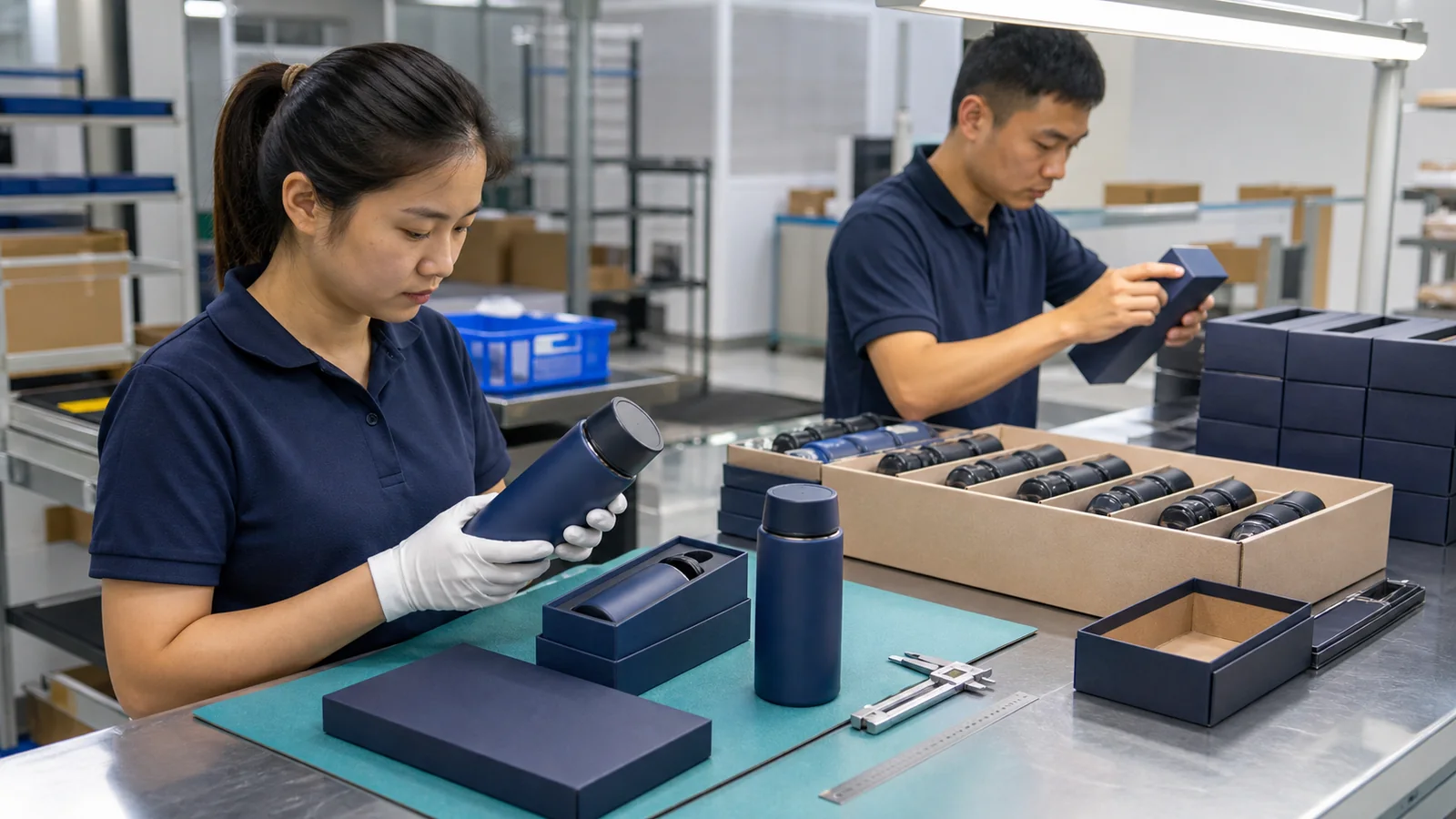
Approve a sample that represents intended materials, dimensions, decoration and packaging. Record tolerances and acceptance criteria before production. “Same as sample” is too vague when colour, logo position, surface finish and fit are commercially important.
Сайт pre-production sample approval checklist can form the sign-off record and help prevent silent changes during the run.
For a custom programme, review:
- dimensions, weight and capacity;
- function under normal and foreseeable use;
- logo size, position, colour and durability;
- edges, odour, finish and cleanliness;
- component compatibility;
- insert retention and opening experience;
- warnings, labels and traceability marks;
- transit protection;
- personalisation data controls, if names are used.
Then test the production schedule. Ask for material lead time, daily capacity, decoration capacity, quality-inspection duration, rework allowance, packaging assembly time, export preparation and transport. Compare those figures with other current orders using the same machines or labour pool.
The broader custom business gift process explains how samples, production and quality control connect. For programmes with distributed destinations, the guide to international small-batch merchandise fulfilment helps frame the later logistics questions.
Gate 7: Confirm quality control and escalation
The purchase order should define what is inspected, when, by whom and against which approved reference. At minimum, agree the inspection stage, sampling method, defect classifications, acceptance limits where used, functional tests and disposition of non-conforming units.
Ask for a corrective-action process with owners and deadlines. If production fails inspection, who decides whether to sort, rework or reproduce? Who pays for reinspection and delayed freight? What evidence closes the issue?
Consider independent inspection when risk justifies it: unfamiliar supplier, tight tolerances, safety-relevant features, complex kitting, high-value order or a programme that cannot be recovered after delivery. Independence does not guarantee quality, but it reduces reliance on unverified self-reporting.
Score only suppliers that pass every mandatory gate
A scorecard creates consistency, but it must sit after the stop/go gates. A supplier with missing mandatory safety evidence remains unapproved even if it scores highly on cost and responsiveness.
Use a 100-point model such as:
| Scored area | Weight | What good evidence looks like |
|---|---|---|
| Product and customisation capability | 20 | Relevant samples, process control, repeatable decoration |
| Quality system and traceability | 20 | Batch records, inspection plan, change control, corrective action |
| Delivery and capacity | 15 | Credible schedule, capacity evidence, recovery plan |
| Commercial transparency | 15 | Complete breakdown, stable terms, disclosed exclusions |
| Packaging and logistics | 10 | Tested pack, carton data, destination plan |
| Communication and project control | 10 | Named owner, accurate records, prompt issue escalation |
| Sustainability and programme fit | 10 | Substantiated material claims and relevant data, not vague badges |
Set thresholds before opening commercial offers. For example, procurement might require every gate to pass, a minimum total score of 75 and no scored area below half its available points. The exact threshold should reflect the buyer’s policy and risk, not this example.
Keep comments and evidence links beside each score. “Good communication: 8/10” is subjective. “Returned complete specification questions within two working days; named an English-speaking project owner; supplied version-controlled action log” is auditable.
A representative approval decision
Consider a procurement team sourcing 800 branded drinkware sets for employees in Germany and the United States. Supplier A quotes 9% less and sends an attractive sample. Supplier B is slower to quote but provides the factory identity, model-linked test reports, batch coding method, packaging data and written change-control process.
Supplier A’s report shows a different model and an unrelated applicant. It cannot explain whether the proposed coating matches the tested sample. Under a gated process, Supplier A is not “saved” by its price score. It is placed on hold until it supplies valid, relevant evidence. Supplier B proceeds to commercial scoring and a production-sample review.
This is a representative procurement scenario, not a LUGVO customer claim. Its point is procedural: due diligence prevents deadline pressure from turning a missing prerequisite into a negotiable weakness.
Record the decision and monitor through delivery
The approval file should contain:
- legal-entity and bank-verification record;
- supply-chain and production-site map;
- product-market requirement matrix;
- verified reports, certificates and declarations;
- recall-search record and date;
- approved sample and specification version;
- bill of materials and controlled changes;
- production, inspection and corrective-action plan;
- packaging and logistics specification;
- mandatory-gate sign-off;
- weighted scorecard and approval conditions;
- expiry or recheck dates for time-sensitive evidence.
Private-label programmes add further questions around ownership, specification and repeatability; the guide to private-label gifts provides that context.
If your team needs sourcing, samples, customisation, packaging and delivery coordinated under one documented plan, LUGVO corporate gifting services can help structure the project. Send the product type, quantity, destination markets, target date and known compliance requirements through the LUGVO services page to request a quote.



 English
  Español
  Français
  العربية
  Italiano
  Deutsch
  日本語
日本語  Nederlands
  Svenska
  Norsk bokmål
  Dansk
Dansk  Suomi
Suomi  한국어
한국어  Ελληνικά
  עִבְרִית
  Română
  Türkçe
  Русский