
A corporate gift unboxing experience is ready only when someone who did not design the pack can identify the sender, open it, understand the contents and deal with the packaging without coaching. Test those four jobs during the first 90 seconds. The time limit is an internal audit device, not an industry standard: it makes hesitation, excess handling and missing information visible while the sample can still be changed.
Do not ask whether the box “feels premium” and stop there. Observe what the recipient tries, where they pause, what they damage and what they put aside. Then translate each behaviour into a packaging, production or fulfilment requirement that a supplier can verify.
The clock is not a delight score
An unboxing test does not measure gratitude, taste or brand affection. Those responses depend on the relationship, the gift itself and the occasion. The test has a narrower job: find avoidable effort between receiving a closed parcel and understanding what to do with its contents.
That boundary matters. A participant can dislike the chosen colour yet open the pack easily. Another can praise the appearance while missing the welcome card, tearing the insert and leaving required instructions in the bottom of the box. The second result is the more serious packaging finding.
The observer should therefore record actions rather than adjectives. “Looked confused” is weak evidence. “Turned the box over twice, pulled the decorative sleeve in the wrong direction and asked where it opened” points to an orientation problem. “Loved it” does not release a sample. “Removed the bottle without touching the decorated surface and found the care card before use” supports a specific decision.
ISO 17480:2015 addresses accessible packaging design with a focus on ease of opening. ISO’s published abstract covers opening location, opening methods and both instrumented and user-based evaluation. This checklist is not a claim of conformity to that standard, but it adopts a useful principle: opening performance should be evaluated with people, not inferred from a designer’s familiarity with the pack.
Prepare one unopened, delivery-ready sample
Test the pack the recipient is expected to receive, not a display sample prepared for a meeting. Include the outer shipper if gifts will travel by parcel, the real closure and seals, production-relevant products, inserts, cards, instructions and any destination-specific information. Use dummy names where personalisation needs testing; do not circulate real recipient data casually.
Before the participant enters, write the test card. It should identify:
- the recipient type and relevant access needs the programme intends to serve;
- the intended delivery route and condition of the unopened sample;
- the four jobs to observe: orient, open, understand and clear away;
- any non-negotiable information or component that must be found;
- the person who owns packaging, product, artwork, fulfilment and compliance decisions.
Select someone who was not involved in the design review. If the programme serves employees in several countries, one colleague at headquarters is not a representative panel. Include the languages, working contexts and practical access needs that could change the result. A 90-second audit can expose friction with a handful of carefully chosen participants, but it does not prove that every recipient will behave in the same way.
Do not rehearse the pack immediately before the test. Place it on a neutral surface, start recording only with permission and give one neutral instruction: “Please open this as if it had just arrived for you.” The note-taker should not point, explain the closure or rescue the participant from a wrong turn. Coaching converts a usability test into a product demonstration.
Let the recipient run the clock
The four windows below are prompts for observation, not universal acceptance limits. Adjust them where the audience, product or safety requirements justify a different test. Keep the order, however: orientation precedes access; access precedes comprehension; disposal should not be judged before all necessary information has been found.
0:00–0:15 — Can they identify and orient the pack?
Watch what the recipient sees before touching the closure. Can they tell who sent the gift without exposing a private message on the shipping label? Is the intended name legible and correct? Does the pack have an obvious upright position? If it was opened by an office reception team, would the inner presentation still reach the right person intact?
Orientation can fail through excess branding as easily as through too little. A sleeve covered in campaign text may obscure the recipient name. A card tucked under the largest item may contain the only explanation of the occasion. Record the first surface the participant examines and every rotation, not merely the time taken.
0:15–0:45 — Can they gain access without improvising?
Note where the hands go, whether the person needs scissors, how much force is used and whether an item or decorated surface is marked during removal. Ribbons, magnets and close-fitting inserts can be satisfying when their direction is clear. They become friction when a knot tightens, a tab has no grip or the recipient must pull the product by its logo area.
Do not turn “easy opening” into “weak closure”. The presentation pack still has to remain closed through its intended handling route, and products must stay separated. A visible pull feature, restrained adhesive or a removable paper band may solve access without sacrificing containment. If the audience includes people with reduced grip, vision or dexterity, test with them or with a qualified accessibility process rather than assuming that an able-bodied colleague can represent their experience.
0:45–1:10 — Do the contents explain themselves?
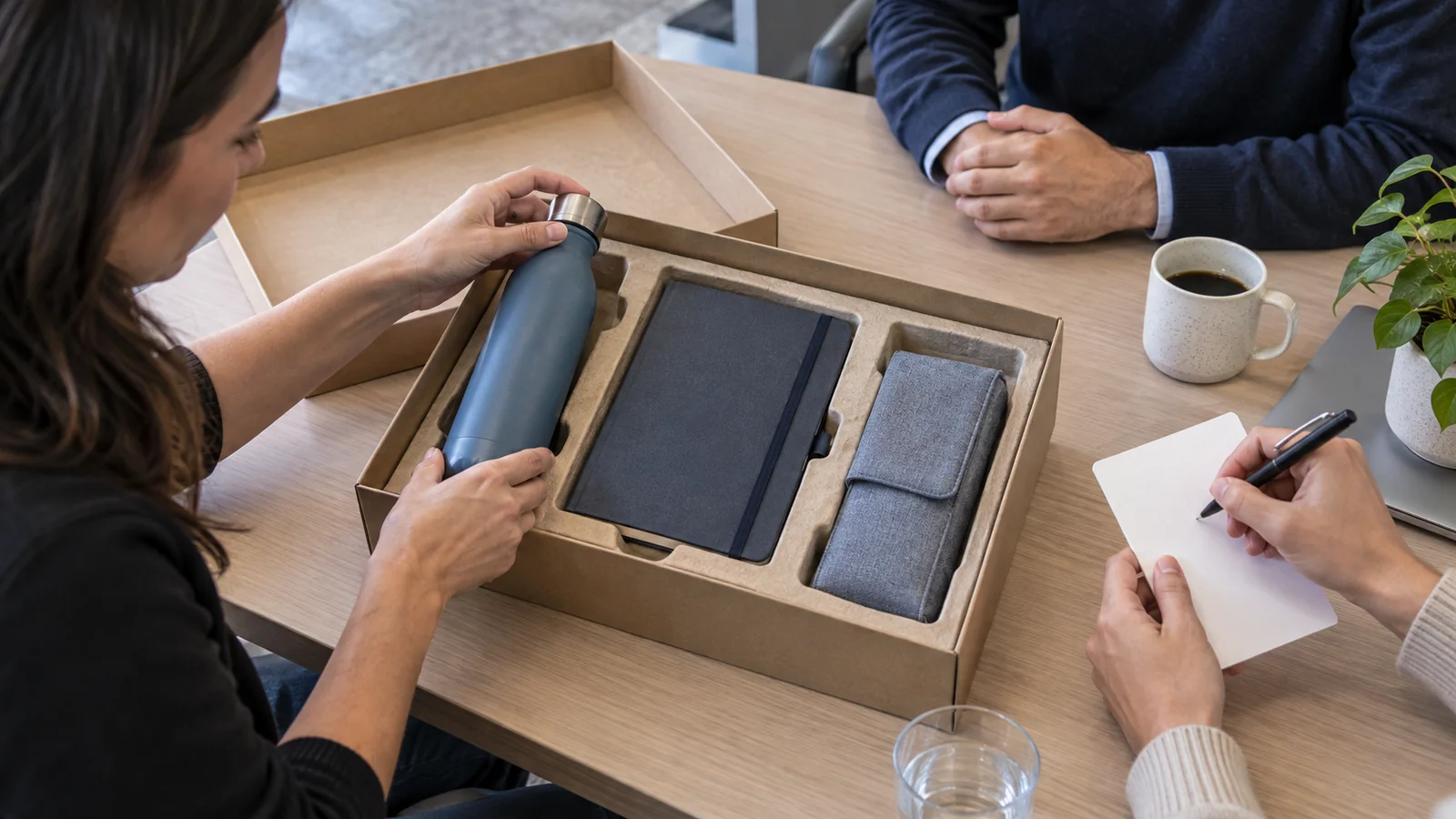
Once the box is open, the recipient should be able to distinguish the gift, accessories and information. Check whether a cable belongs to the device, whether a refill or adaptor is mistaken for packaging waste, and whether the welcome message appears before transactional paperwork. A QR code should not be the only route to essential information when connectivity, device access or the code’s future ownership is uncertain.
Required product identification, warnings and instructions cannot be replaced by a stylish card. For EU programmes, the European Commission's product-safety guidance treats a product's presentation, labelling, warnings and safety information as relevant to safety assessment. The responsible compliance owner should decide which rules and languages apply to the specific product and market. The unboxing audit simply checks that approved information remains present, legible and reachable at the correct moment.
1:10–1:30 — Is the aftermath understandable?
Observe what remains on the surface. Can protective film be distinguished from a reusable pouch? Are mixed materials easy to separate where separation is intended? Does the participant know whether a rigid box is designed for continued use, or does the pack create a pile of layers with no continuing job?
Avoid promising recyclability from appearance alone. Material composition, local collection systems, labels and contamination all affect the answer. For packaging placed on the EU market, the European Commission reported that the Packaging and Packaging Waste Regulation began phased application on 12 August 2026, while measures such as specific empty-space limits have later dates. Record the actual packaging system and obtain market-specific advice; do not turn a future milestone into a current blanket claim.
The practical design question is immediate: which layer protects, informs, presents or supports reuse? A layer with no defensible job deserves removal or redesign. The earlier LUGVO breakdown of corporate gift packaging cost factors shows how unnecessary volume and assembly can also change landed cost.

Replay a representative 600-kit pack
Consider a procurement team preparing 600 year-end client kits for Germany, France, the United Kingdom and the United States. Each kit contains an insulated bottle, an A5 notebook, a cable organiser and a message card. The first sample has a ribboned rigid box inside a corrugated parcel shipper. This is a representative example, not a claimed LUGVO client order.
Four uncoached participants receive closed samples. The first turns the inner box three times because the ribbon covers the opening seam. The second reaches the bottle in 32 seconds but lifts it by the printed mark, leaving a visible fingerprint on the finish. The third discards the small cable-organiser band before realising that it contains the material and care note. The fourth finds the message only after removing the complete insert.
None of those findings says that rigid boxes, ribbons or inserts are inherently wrong. They show that this combination assigns the wrong jobs to them. The revised sample moves the message to the first opening surface, replaces the tied ribbon with a paper sleeve carrying a clear pull direction, adds a finger recess away from the decorated face and integrates the product note into a card that cannot be mistaken for void fill.
The team runs the same observation again with fresh participants; it does not show the revision to the first group and ask whether it is “better”. The second sample removes the repeated rotations and accidental disposal. One participant still catches the notebook corner on the insert. That issue goes back to packaging engineering with a measured clearance requirement rather than being accepted as personal preference.
Diagnose the layer that caused the friction
Do not send every observation to the packaging designer. The visible problem may begin elsewhere.
Pack architecture owns unclear openings, trapped products, unstable presentation order and layers without a purpose. Production execution owns inconsistent folds, excessive adhesive, rough die cuts and insert dimensions outside the approved tolerance. Fulfilment owns swapped cards, wrong orientations, missing accessories and shipping labels placed over an opening feature. Product information owns absent or unreadable care, warning and identification material. Programme design owns a gift or message that does not fit the recipient group.
Assigning the right layer prevents decorative fixes from hiding operational defects. A larger arrow cannot solve an insert cut too tightly. A different ribbon cannot solve a warehouse that packs the message card underneath the products. A premium box cannot make an unsuitable item relevant.
The 90-second observation also does not prove transport protection. The International Safe Transit Association describes its 3-Series procedures as general simulations of damage-producing transport motions, forces, conditions and sequences; Procedure 3A addresses individual packaged products moving through parcel-delivery systems at 70 kg or less. Select any distribution test with a competent packaging specialist for the actual product, pack and route. A pack should pass both journeys: the logistics journey while closed and the recipient journey after arrival.
Use the existing corporate gift sample approval checklist to identify the sample revision and record what it proves. The unboxing audit adds behavioural evidence; it does not replace the dimensional, functional, branding, packaging or lot-inspection decisions in that approval.
Write the result into the specification
Close the audit by converting each material observation into a requirement, test or work instruction. “Make it easier” is not enough. Useful wording might specify that the intended opening point must be found by the selected participant group without coaching; normal opening must not require an extra tool unless the brief deliberately permits one; the primary item must be removable without touching its decorated face; and approved product information must remain visible and attached through fulfilment.
Keep the context beside the result. Name the sample revision, participant profile, destination version, test condition, observed action, timing, consequence, owner and required recheck. If the outer shipper was omitted, the record must say so. If a participant already knew the pack, exclude that result rather than making it look cleaner.
There are three honest outcomes. Pass means the defined audience completed the four jobs and no unresolved issue could change safety, comprehension, product condition or intended presentation. Revise and replay means a named change is required and must be tested on the next physical version. Stop and redesign means the structure, product mix or information sequence is fundamentally wrong. “Approved with comments” is useful only when every comment has an owner and a later verification point.
Keep aesthetic development in its proper place. The LUGVO article on custom gift boxes and gift wrap explores structure, materials and visual expression; this audit decides whether the chosen expression works in a recipient’s hands. One page should not compete with the other.
Before requesting a quote, send the supplier the product set, quantities, destinations, delivery method, required-in-hand date, participant profile and observed issues from the current sample. LUGVO branded merchandise solutions can connect product sourcing, customisation, packaging and international delivery to that evidence. The LUGVO services page provides the route to share the brief and request a quote.



 English
 Español
 Français
 العربية
 Italiano
 Deutsch
 日本語
 Nederlands
 Svenska
 Norsk bokmål
 Dansk
 Suomi
 한국어
 Ελληνικά
 עִבְרִית
 Română
 Türkçe
 Русский