
Shipping promotional products with lithium batteries is possible only after the exact battery, product configuration, transport mode, route and carrier have been cleared together. A branded power bank is treated as a battery for air transport; earbuds and consumer trackers are generally equipment containing a battery. Those are not interchangeable shipping descriptions. Before production, obtain product-linked battery data and the UN 38.3 test summary, freeze the battery and device model, and appoint a qualified dangerous-goods specialist. Before collection, that specialist must confirm classification, packing route, marks, documents, training and any state or carrier variations for the actual consignment.
Procurement should run six chronological go/no-go gates. If any gate is open, hold the affected product or route. A courier quotation, an attractive sample or a generic “battery certificate” does not close the gap.
Gate 1 — before the purchase order: identify what will actually ship
Start with the physical item, not the campaign name. “Tech gift set” tells the transport team almost nothing. Record the product model, battery chemistry, battery model, rated energy in watt-hours, cell or battery count, whether it is rechargeable, and how the battery sits in the product.
The configuration changes the transport assessment:
- A power bank primarily supplies power to another device. IATA’s 2026 guidance says power banks are classified as batteries, not as equipment containing batteries.
- Wireless earbuds and their charging case are equipment containing installed batteries when offered in that assembled configuration.
- A Bluetooth item finder given to a recipient is also a product being shipped. Do not confuse it with IATA’s provisions for a cargo-tracking device that is active because it is tracking the consignment itself.
Also identify everything packed in the presentation box. An extra loose cell, a spare power bank or a substituted charging case can change the configuration after the main product was approved. The corporate gift specification sheet checklist shows how to keep component identity and revision under control.
Go: one product-and-battery record matches the quotation and sample. No-go: the supplier cannot name the battery model, energy rating or installed/loose configuration.
Gate 2 — before sample approval: connect evidence to the exact model
Lithium cells and batteries offered for transport must have passed the applicable UN Manual of Tests and Criteria, subsection 38.3 tests. Both IATA’s 2026 Battery Guidance Document και US DOT PHMSA guidance direct buyers and shippers to obtain a test summary from the manufacturer, distributor or vendor. The summary must be available on request; IATA does not say that a copy must travel with every shipment.
Treat the summary as linked evidence, not a badge. Match its manufacturer or distributor, model identifiers, physical description, test-report references and rated energy to the battery in the approved product. A report for a similar power bank, a bare cell or last year’s charging case does not prove that the ordered assembly is covered. A safety data sheet alone is not a substitute for transport classification; IATA warns that such sheets may not identify the correct transport information for an article.
Use the corporate gift supplier due diligence checklist for the broader legal-entity, factory and change-control review.
Go: the evidence can be traced to the exact production configuration. No-go: the supplier provides only a generic declaration, cropped report or unrelated model.
Gate 3 — before production: freeze the battery and appoint the specialist
Brand artwork can proceed while evidence is reviewed, but volume production should not start with an unnamed battery inside the sample. Freeze the cell or battery manufacturer, model, electrical rating, protective circuitry where applicable, device model, charging components and intended pack-out. Require written approval before any change.
Now bring in a dangerous-goods specialist competent for the intended modes and jurisdictions. This should happen before cartons and inserts are finalised, because transport requirements can affect quantity per package, protection, package performance, marks and paperwork. The specialist should work from the current regulations, not this article, supplier habit or an old courier label.
The buyer’s role is to give that person reliable facts and decision authority. Ask for a written classification and acceptance basis that names the product revision, configuration, origin, destination, modes and proposed carrier. Do not ask procurement staff to select packing instructions or reproduce dangerous-goods labels from an online example.
Go: the controlled product revision has an assigned technical reviewer and a documented regulatory route. No-go: “our forwarder shipped these before” is the only basis.
Gate 4 — before carton sign-off: test the real packed system
The presentation box is not automatically the transport package. Review the complete pack-out, including product restraints, accessories, retail packaging, dividers, cushioning and outer cartons. The specialist and packing provider must determine the applicable method; the buyer should verify that the approved design prevents product movement, damage and unintended operation through the planned network.
State of charge also needs an owned decision for air consignments. Under IATA’s rules effective in 2026, lithium-ion batteries shipped alone, including power banks, are subject to reduced state-of-charge requirements. The 2026 guidance also makes a reduced charge mandatory for specified lithium-ion batteries packed with equipment, while describing reduced charge for batteries contained in equipment as a strong recommendation rather than a universal mandate. Exact application depends on the classification and section, so have the specialist specify the production setting, verification method and exceptions for the actual shipment.
Do not solve this by telling the factory “ship at 30%” without a controlled method. A display reading, indicator light and measured state of charge are different things. The production and quality plan must say what is checked, when, on which units and against which approved requirement.

Go: final product, retail pack, outer pack and charge-control record have been reviewed together. No-go: the courier is expected to redesign the package at collection.
Gate 5 — before booking: obtain lane-specific carrier acceptance
Regulatory compliance does not compel every carrier, service or account to accept every shipment. IATA notes that state and operator variations can add requirements. Carrier policies also change by origin, destination, service and customer approval status.
For example, DHL Express US guidance says some lithium-battery shipments require a pre-approved account and that not all types are accepted. FedEx US guidance directs shippers to current service terms and identifies carrier-specific variations. These are examples, not global approvals for a LUGVO order or another carrier’s network.
Send the carrier or authorised dangerous-goods desk the product classification, configuration, quantity, packed dimensions and weights, origin, destination, service, account details and specialist-prepared documents. Obtain a reference or written response that operations can retrieve. Reconfirm when the lane, quantity, product revision or service changes.
| Product offered | First transport question | Buyer’s release evidence | Hold when… |
|---|---|---|---|
| Branded power bank | Is it being offered as a battery on this route? | Product-linked test summary, specialist classification and carrier acceptance | It is described as a charger “contained in equipment” |
| Earbuds with charging case | Are all batteries installed in the approved equipment configuration? | Assembly record, battery evidence, pack review and lane confirmation | A loose replacement battery or power bank is added |
| Recipient item tracker | Is it a shipped product rather than a device tracking this consignment? | Product configuration, battery chemistry/rating and route decision | The cargo-tracker exception is assumed from the word “tracker” |
Go: the named carrier and service accept the actual consignment. No-go: the team has only a retail booking screen or a generic sales quote.
Gate 6 — at handover: reconcile cartons, records and condition
Before release, reconcile the purchase order, product revision, quantity, carton count, gross weight, battery classification, evidence reference, carrier approval and shipment documents. Keep customs information consistent, but do not collapse the two reviews: the customs information for branded merchandise concerns product identity, value, origin and import decisions; dangerous-goods acceptance concerns safe transport.
Inspect for damage, swelling, leakage, overheating, recall status or unexplained battery substitutions. Stop and escalate any suspect unit. IATA states that batteries identified as defective for safety reasons, damaged batteries capable of dangerous heat, fire or short circuit, and affected equipment are forbidden by air. PHMSA likewise treats damaged, defective and recalled batteries as a distinct, higher-risk case under US rules. Returns and recycling therefore need a separate specialist-led process; do not place them into the outbound gift workflow.
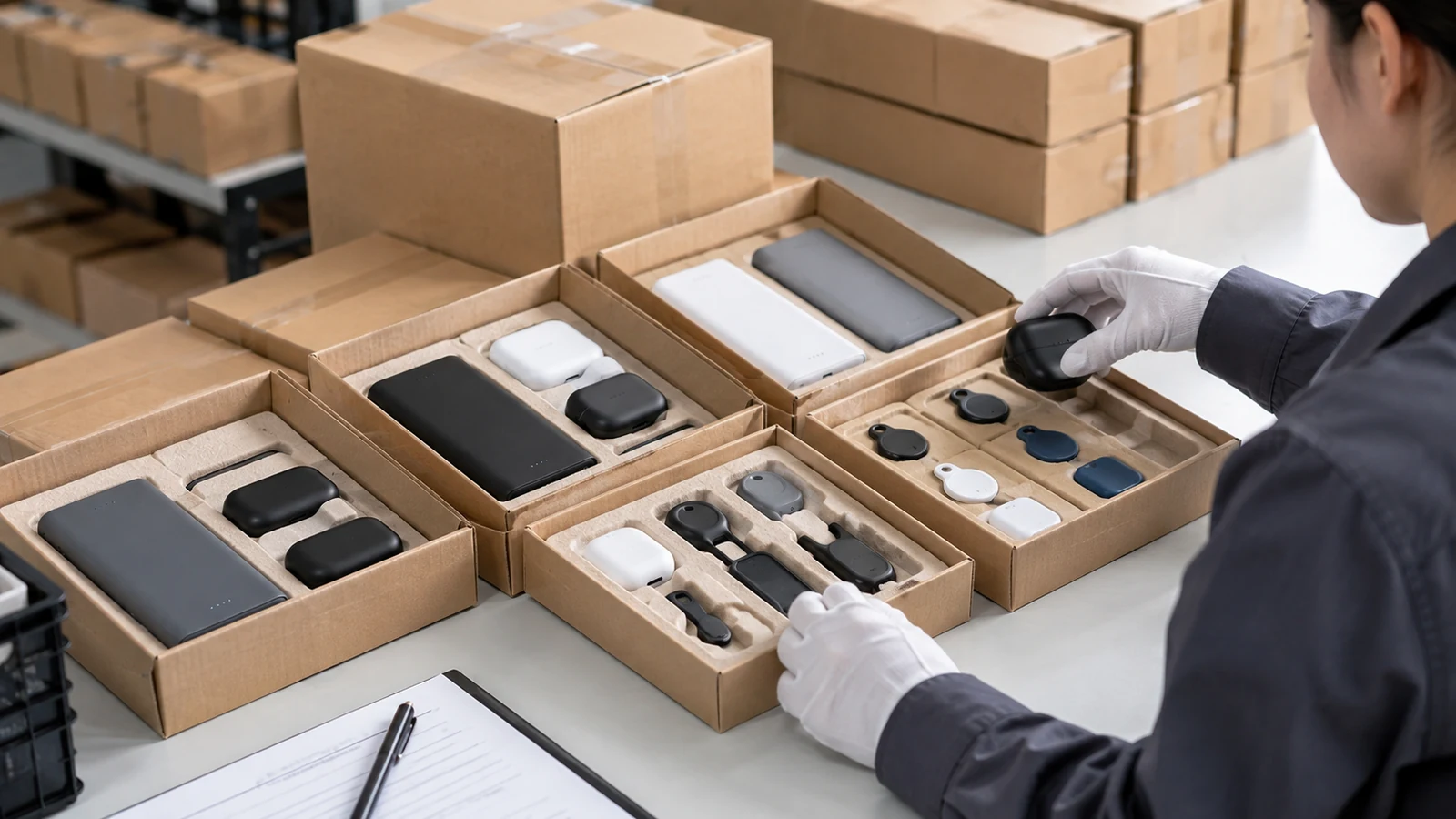
Release only the cartons that match the approved record. Record who checked them, the date, the carrier reference and any held quantity.
A representative failed handover
A marketing team orders 900 presentation boxes for customer meetings in Germany and the United States. Each box contains earbuds, a notebook and what the supplier calls a “wireless charger”. The sample is approved visually, and the courier quote says “electronics”. Two days before collection, the packing list reveals that the charger is actually a power bank. The supplier sends a UN 38.3 report for a different capacity and cannot identify which cell entered production.
The forwarder pauses the air booking. Reprinting the commercial invoice would not fix the failure: product identity, test-summary coverage, classification, charge control, package review and carrier acceptance are all unresolved. The correct response is to hold the power banks, have a qualified specialist review evidence and routes, and decide whether compliant stock can move later. If the non-battery components are still useful as a complete recipient proposition, they may be released as a separately approved pack. Nobody should conceal the battery or relabel it as an accessory to save the event date.
This representative scenario is not a LUGVO customer order. It shows why the cheapest intervention occurs at Gate 1, before custom packaging and meeting dates turn a missing battery record into a programme delay.
Release the order only when the six answers agree
The compact sequence is: identify → evidence → freeze → pack → accept → reconcile. It is a chain, not a scorecard. Five passes cannot compensate for one failed safety or carrier gate.
Use the air-versus-sea freight guide after a compliant cargo configuration exists; it answers the separate route-and-deadline question. For sourcing, customisation, packaging and delivery planning, LUGVO can coordinate the commercial programme around the technical release points. Send the quantities, exact products, battery data, destinations and required-in-hand dates through the LUGVO services page to request a quote. For every live shipment, the appointed dangerous-goods professional and accepting carrier must confirm the current legal and operational requirements.




 English
 Español
 Français
 العربية
 Italiano
 Deutsch
 日本語
 Nederlands
 Svenska
 Norsk bokmål
 Dansk
 Suomi
 한국어
 Ελληνικά
 עִבְרִית
 Română
 Türkçe
 Русский