
Two corporate gift samples can look identical on a meeting table and still represent different orders. One may use the agreed stainless-steel grade, colour reference and protective insert. The other may use a substituted liner, a visually similar coating and packaging that has never been tested for parcel delivery. A visual review alone cannot tell procurement which version will enter production.
A corporate gift specification sheet should be the controlled source of truth for the product, branding, packaging, evidence and approved deviations. It needs to state what is required, how conformity will be judged, who owns each decision and which revision production may use. The checklist below turns a creative brief into an order that a supplier, inspector and fulfilment team can all interpret in the same way.
Build one controlled record, not a longer email chain
A mood board explains direction. A quotation records a commercial offer. Artwork controls visual content. A sample demonstrates selected physical characteristics. None of them, by itself, defines the complete order.
Create one product record with a project code, item code and revision number. It can link to artwork, test reports and packing instructions, but it should name the approved version of every linked document. “Use the latest logo” or “same as the sample” creates an avoidable dispute because neither phrase identifies a fixed file or measurable requirement.
The record should cover eight areas:
- product identity and intended use;
- construction, components and materials;
- dimensions, capacity, weight and fit;
- colour, finish and decoration;
- function and performance checks;
- labels, markings and market evidence;
- presentation and transport packaging;
- inspection, change control and release authority.
ISO describes ISO 10007:2017 as guidance for configuration management across a product or service life cycle. The standard remains current after confirmation in 2023. A corporate gift order does not need to imitate an engineering programme, but the underlying discipline is useful: identify the configuration, control changes and retain a record of what was approved.
Write requirements that another person can verify
“Premium”, “strong”, “eco-friendly” and “close to the brand colour” express preferences, not acceptance criteria. Replace them with specific product facts and a way to produce evidence.
Separate the requirement from the evidence
A requirement states the result. Evidence shows why the team accepts that result. Keeping the two separate prevents a supplier document from quietly becoming the requirement.
| Control field | Weak entry | Controlled entry |
|---|---|---|
| Material | Recycled fabric | Main shell: agreed recycled-polyester construction; supplier declaration linked by revision |
| Colour | Brand blue | Physical colour reference, named substrate, finish and approved tolerance method |
| Logo | Small white logo | Artwork revision, method, position, maximum size and orientation during normal use |
| Capacity | Large bottle | Nominal capacity, test method and permitted dimensional or fill variation |
| 패키징 | Gift box | Board construction, insert, closure, pack-out sequence and transport carton |
| Evidence | Certificates available | Required report or declaration, issuing party, product scope, market and validity review |
Evidence must match the actual product. A material declaration for a similar stock item does not automatically cover a custom-colour batch. A test report for one electrical configuration may not cover a revised battery, charger or plug. Record the model, materials, factory and market scope that connect the evidence to the order.
Give tolerances a business reason
Not every feature needs an instrument reading. A lid must fit; a logo must be correctly oriented; a presentation box must arrive without visible crushing. Some checks can be pass or fail. Others need a numeric range or an agreed visual limit.
Use tight tolerances where variation affects safety, function, assembly, brand identity or pack-out. Allow practical production variation where it does not change the recipient experience. An unnecessarily narrow tolerance can increase rework and cost without creating useful quality. An undefined tolerance moves the decision to whoever sees the batch last.
For subjective features such as natural-grain variation, recycled-fibre specks or minor engraving differences, retain approved photographs or physical boundary samples. State what the image illustrates and what it does not. A photograph can show the maximum acceptable surface mark; it cannot reliably establish an exact colour under every screen and lighting condition.
Describe the complete product system
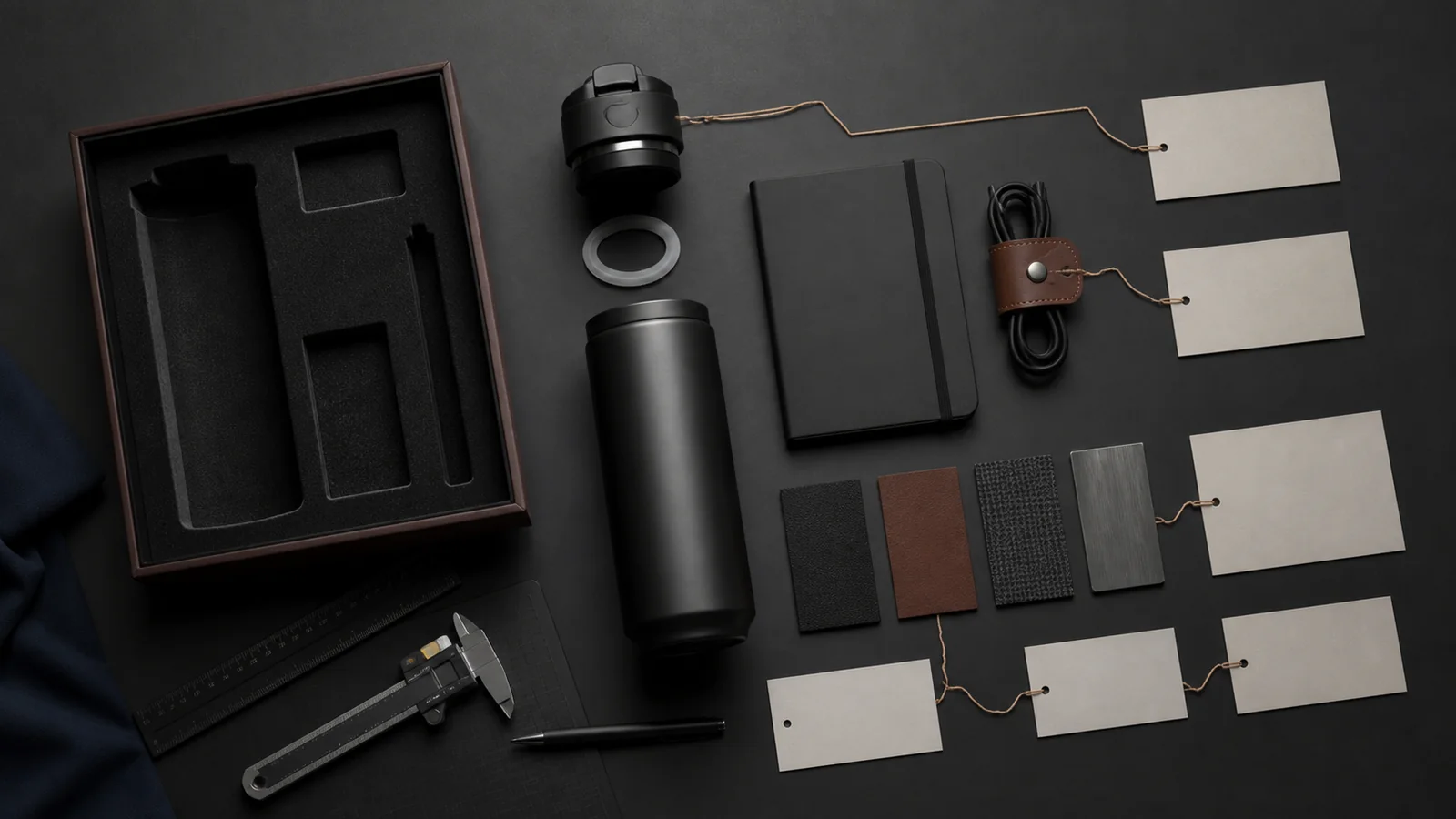
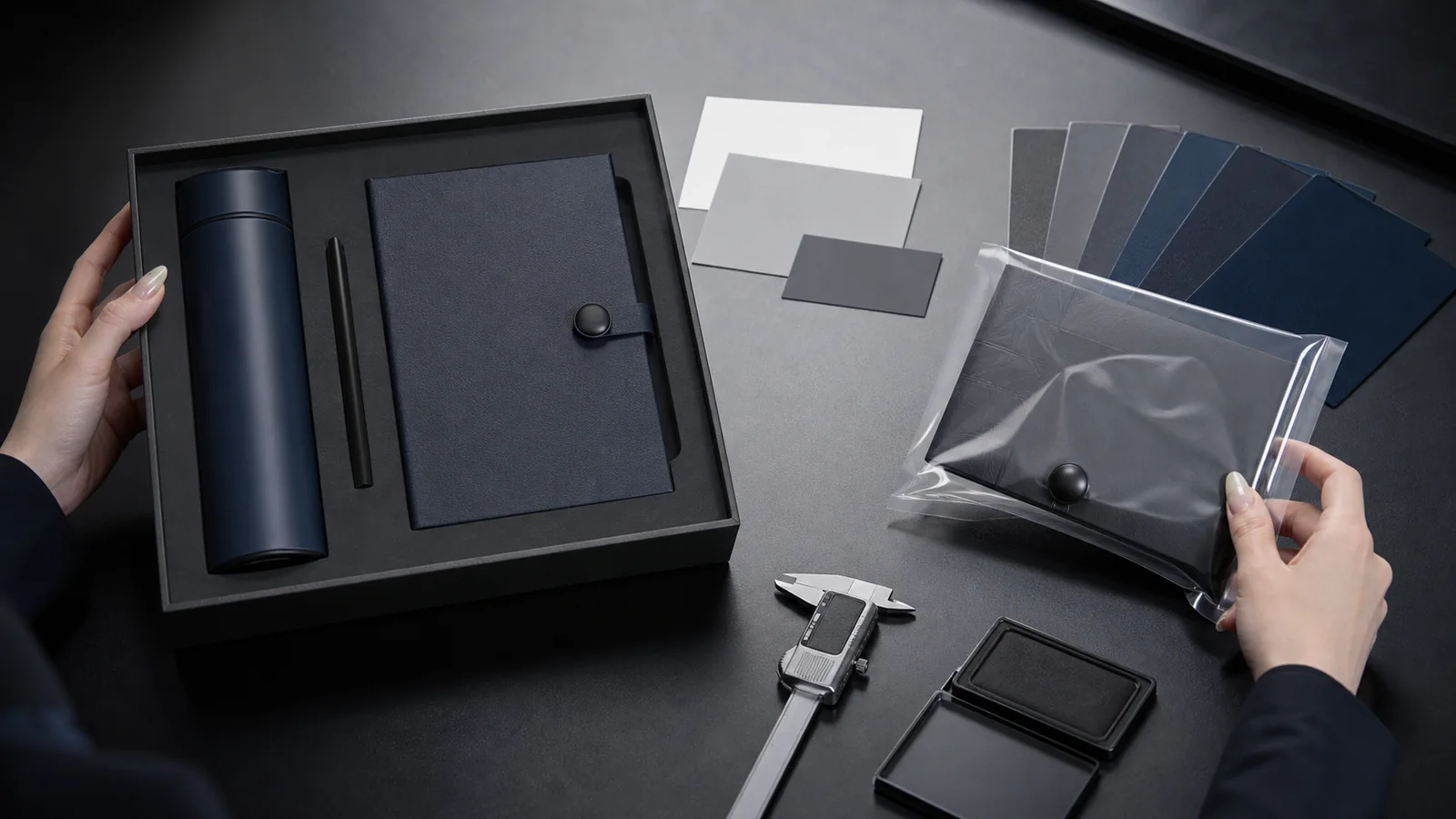
The saleable gift is more than the main item. Include every component that must arrive together: cable, adaptor, refill, instruction leaflet, card, sleeve, insert, tissue, seal and outer carton. Specify component quantities and the pack-out sequence.
This matters when different factories make the product and packaging. A box approved before the final cable or lid arrives may not close correctly. A printed card can transfer ink onto a light-coloured surface. A neat presentation insert can fail after the complete set passes through parcel handling. The specification should connect the components rather than treating them as separate purchases.
Assign ownership before revisions begin
Requirements often come from different teams. Brand owns artwork and visual hierarchy. Procurement owns the commercial record and supplier communication. A technical or compliance owner reviews market requirements and evidence. Operations owns fulfilment data and pack-out. Finance may approve cost changes. Give each field one accountable owner even when several people contribute.
Control revisions at field level
Use a short change log with:
- the requested change and reason;
- affected product, artwork, packaging and evidence fields;
- cost, timing and risk impact;
- required revalidation or new sample;
- decision owner, date and resulting revision.
A change to bottle colour may affect only coating and visual approval. A change to the lid may affect fit, leak testing, packaging clearance and carton weight. Treating both as “sample updates” hides the second change’s wider effect.
Do not allow production to work from a file whose approval status is unclear. Use simple states such as working, submitted for review, approved for sample and released for production. Only one revision should be released. Superseded versions remain in the archive but are visibly marked so they cannot return through an old email attachment.
Link the specification to the physical sample
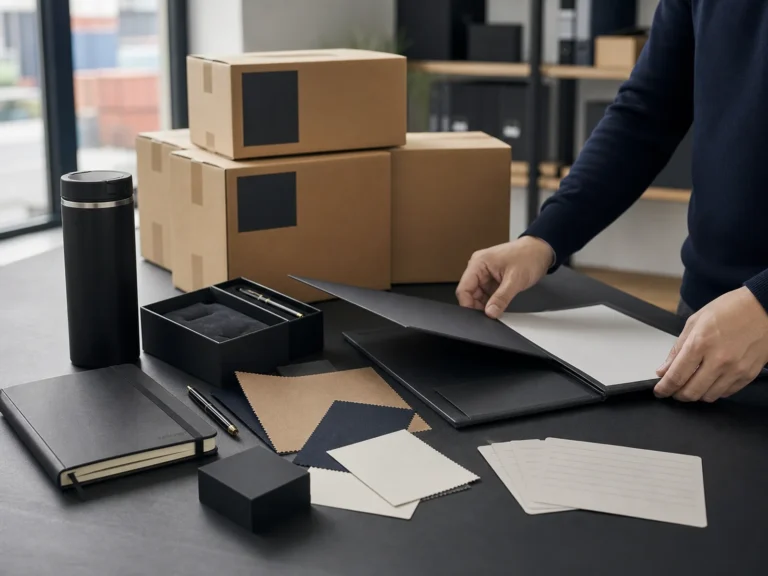
The specification tells reviewers what the sample is meant to prove. The sample gives physical evidence against those requirements. Keep the two connected by item code and revision.
그리고 corporate gift sample approval checklist covers how to inspect and retain the physical reference. It should remain a separate gate. Approving a sample does not fill gaps in the written specification, and signing a specification does not prove that the sample or production lot conforms.
Supplier capability is also a different question. Use the corporate gift supplier due diligence checklist to evaluate identity, evidence and production capability before relying on the specification as a control document.
Worked example: a 600-unit desk set
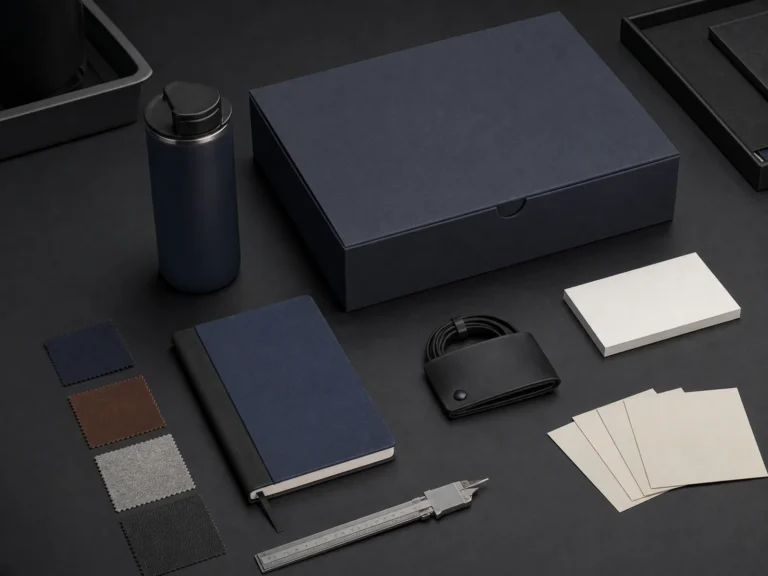
Consider a procurement team ordering 600 desk sets for client workshops in Germany, France and the United Kingdom. Each set contains a powder-coated bottle, an A5 notebook, a cable organiser, a printed card and a rigid presentation box.
The first brief calls for “navy products with a subtle white logo”. The controlled version separates the decisions:
- the bottle has a named model, capacity, material construction, lid configuration and coating reference;
- the notebook has a defined page count, ruling, paper requirement, cover material and logo method;
- the cable organiser has an agreed size range and must close around the intended cable bundle;
- each artwork file has a revision, position and maximum decoration area;
- the box record states board construction, insert geometry, component orientation and shipping-carton quantity;
- country and product markings are reviewed by the relevant compliance owner for each destination;
- the complete packed-set weight and carton dimensions are confirmed before freight booking.
During sampling, the bottle coating is approved but the cable organiser is replaced because its closure marks the notebook. That substitution changes the component code, dimension, material declaration, insert cut-out and packed weight. The change log names all five effects. Procurement issues revision C only after the new organiser fits, the insert is updated and the evidence list is rechecked.
The record is not complicated for its own sake. It prevents a seemingly small component change from reaching final inspection with no agreed basis for acceptance.
Release production with a closed decision record
Before a deposit, tooling release or production start, the owner should be able to answer five questions without searching through messages:
- What exact product and packaging revision is being ordered?
- Which requirements are mandatory, and which variations are permitted?
- What evidence and physical references support approval?
- Are any deviations still open, and who may accept them?
- Which changes require a new sample, evidence review or commercial approval?
The production-release page should list the item and document revisions, approved deviations, unresolved conditions, accountable signatories and release date. “Approved with conditions” is not a release unless each condition has an owner, verification method and closure point.
The official ISO 9001:2015 page provides the wider quality-management context for consistently meeting requirements and improving processes. The practical lesson for corporate gifting is narrower: production should begin from an identified, reviewed and controlled requirement set—not from collective memory.
A good corporate gift specification sheet does not try to predict every possible defect. It removes ambiguity from the decisions the team has already made and creates a disciplined route for later changes. Once product, artwork, packaging, evidence and ownership are connected, sample approval and production inspection have something reliable to test.
For support turning a gift concept into a controlled sourcing, customisation and production plan, LUGVO works with international business buyers. Review the LUGVO services page and request a quote with the quantity, destinations, artwork status, required-in-hand date and current product brief.


 English
 Español
 Français
 العربية
 Italiano
 Deutsch
 日本語
 Nederlands
 Svenska
 Norsk bokmål
 Dansk
 Suomi
 한국어
 Ελληνικά
 עִבְרִית
 Română
 Türkçe
 Русский