
A corporate gift sample is ready for approval only when it represents a named specification and the decision is recorded against measurable criteria. “Looks good” is not a production instruction. Confirm the sample version, materials, dimensions, function, colour, logo method, packaging, labelling and permitted tolerances; photograph it; record every exception; and keep a sealed reference sample.
Approval also has limits. It authorises production to an agreed specification, but it does not prove that every production unit will conform. Shipment release still requires an appropriate inspection plan. This corporate gift sample approval checklist turns a physical object into a controlled hand-off between brand, procurement, supplier and quality teams.
First identify what the sample proves
Not every sample is made by the final process. A stock sample may prove size and general function but not colour or branding. A digital mock-up shows artwork placement but not adhesion, engraving depth or print opacity. A handmade prototype may prove the concept while hiding variation that will appear on production equipment.
Label the sample type in the approval record:
- reference sample: an existing item used to assess general form or quality;
- development prototype: a trial used to resolve design or construction;
- decoration sample: a production-relevant test of logo method, colour and position;
- pre-production sample: an item intended to represent the approved materials and manufacturing route;
- packaging sample: the complete presentation and protective pack;
- golden sample: the signed, controlled reference retained for production comparison.
Do not let one sample silently change role. If a stock bottle receives a trial print, its approval should not imply that the future custom-colour bottle has also passed fit, finish and performance checks.
Record identity and version before appearance
Give each sample a project code, item code, revision, date and supplier reference. Note where it was made, which tooling or process was used and whether any planned production component is missing or substituted. Attach the approved artwork and specification revision rather than referring to “the latest file”.
The approval page should identify:
- sample type and quantity received;
- product and packaging revision numbers;
- purchase-order or brief reference;
- intended production site and decoration site;
- approvers for brand, procurement and technical requirements;
- open deviations and the person authorised to close them;
- photographs under neutral lighting;
- approval status: approved, approved with conditions, revise and resubmit, or rejected.
An approval with conditions needs a verification method. “Make the blue slightly darker” is not closed. “Match approved colour reference X within the agreed production tolerance, verified on the next sample” can be acted on.
Inspect the product as a specification
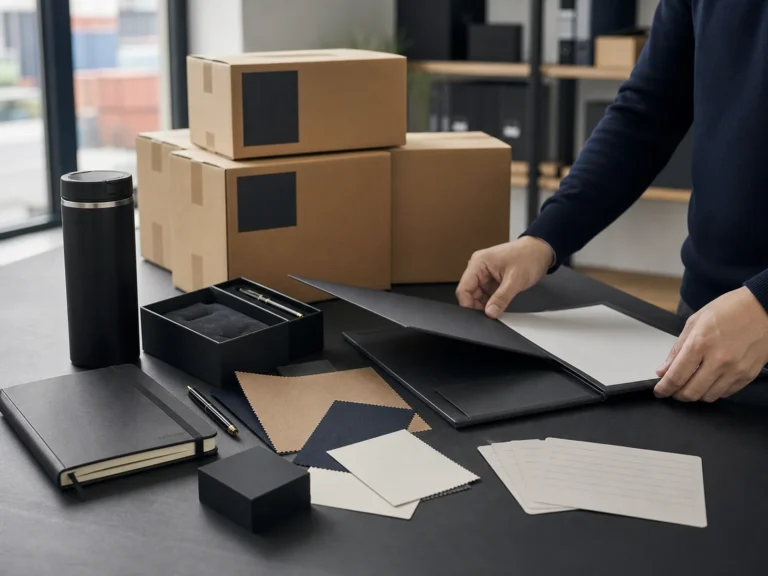
Use calibrated tools where measurements matter. Compare against the purchase specification, not memory. The following matrix is a starting point; product-specific safety, compliance and performance requirements may add more checks.
| Area | What to check | Evidence to retain |
|---|---|---|
| Identity | Item code, revision and component set | Labelled photographs and sample log |
| Materialer | Substrate, grade, texture, odour and finish | Material declaration or agreed reference |
| Dimensions | Overall size, capacity, weight and fit | Measurement record and tolerances |
| Function | Opening, closure, assembly, charging or writing | Test method and result |
| Surface | Scratches, dents, mould marks, sharp edges | Defect photographs and limit samples |
| Colour | Product, trim and packaging colours | Physical colour reference and lighting condition |
| Decoration | Method, location, size, opacity and registration | Artwork overlay and measured position |
| Personalisation | Data accuracy, typeface and variable placement | Approved test records using dummy data |
| Labelling | Required marks, care, warnings and origin | Artwork revision and placement photograph |
| Pack-out | Components, inserts, orientation and protection | Pack-out instruction and complete sample |

Touch and use the item as a recipient would. Open the lid repeatedly, fit the cable, write with the pen, insert the notebook, close the gift box and remove the product without tearing the insert. A premium appearance can distract reviewers from a poor closure, unstable base or packaging that cannot be repacked after inspection.
Approve branding under realistic conditions
Logo approval needs more than spelling and size. Check contrast on the actual material, fine-line reproduction, clear space, orientation during normal use and visibility after the product is assembled. Inspect curved and textured surfaces from several angles. For engraving or debossing, agree depth and edge quality; for print, agree opacity, registration and acceptable pinholes.
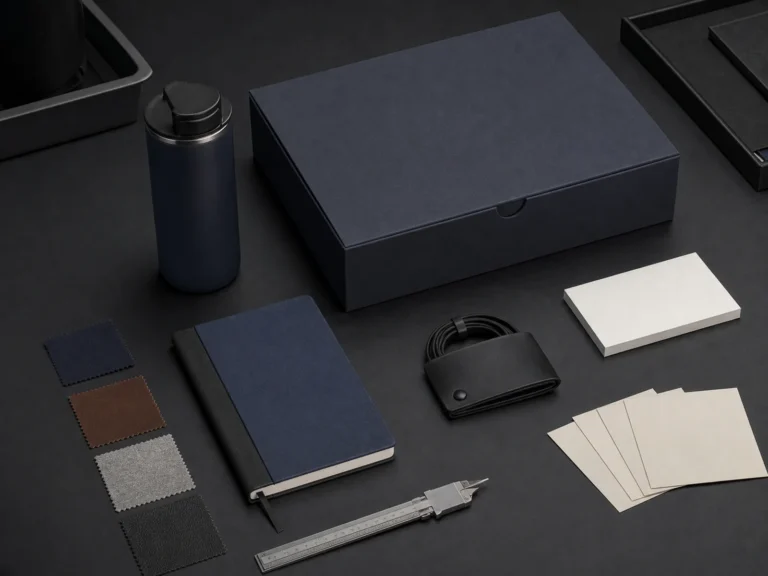
Use the final artwork format and colour references named in the specification. Screens and office printers are not reliable physical colour standards. If exact matching is technically limited by substrate or decoration method, document the achievable range before approval rather than arguing about it after production.
Personalised products require a separate data test. Use fictional records that include long names, accented characters, hyphens and the shortest and longest expected strings. Confirm truncation rules, capitalisation, character support, file mapping and how failed records are quarantined. Do not use real recipient data for casual sample circulation.
The article on branded merchandise people keep helps decide whether the product is worth branding. The sample record then controls how that brand decision is executed.
Test the complete packaging system
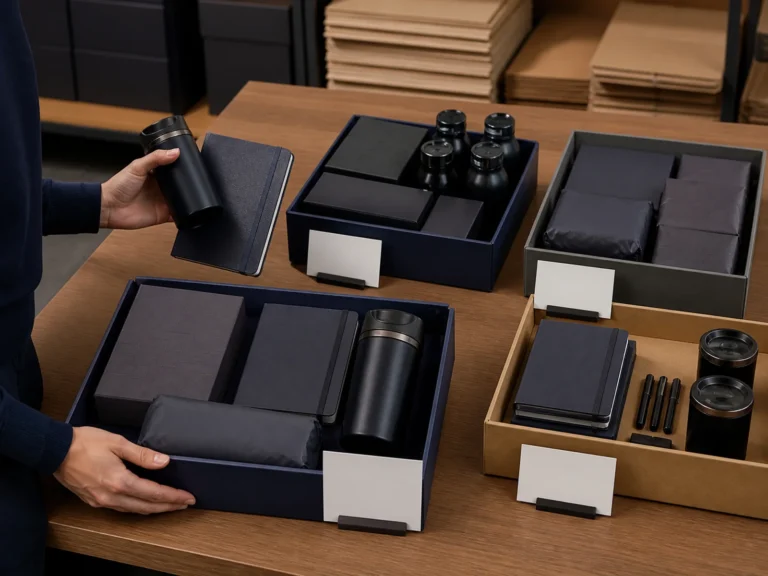
Presentation packaging has two jobs: create the intended opening experience and protect the item through its actual distribution route. Approve the complete pack-out, including tissue, insert, accessories, cards, labels, seals and outer shipping carton where relevant.
Check that:
- the product cannot move enough to scuff or break;
- inserts hold their shape after handling;
- surfaces do not transfer colour or adhesive;
- the gift can be inspected and repacked consistently;
- barcodes and carrier labels have a flat, usable area;
- packaging dimensions and weight match freight assumptions;
- mixed or personalised components cannot be swapped;
- country-specific labels can be applied without covering the design.
A packaging sample photographed without the shipping carton proves only presentation. If the programme uses parcel delivery, test the parcel configuration. If it uses palletised bulk delivery, approve pallet pattern, carton quantity and handling marks as well.
For a deeper view of product, packaging and production decisions, use the custom business gifts process guide and the private-label gifts guide.
Define defects before production
Reviewers need a shared language for nonconformity. A practical classification is:
- Critical: a condition that may create a safety, legal or serious use risk, or makes required traceability unreliable.
- Major: a defect likely to cause rejection by the buyer or recipient, such as wrong logo, failed function, missing component or prominent damage.
- Minor: a departure that does not materially affect use and is unlikely to cause rejection, such as a small cosmetic variation within an agreed limit.
Classifications depend on the product and market. A sharp edge may be critical; a small colour variation may be minor on recycled fabric but major on a tightly controlled executive set. Add photographs or physical limit samples for subjective features. Words such as “reasonable”, “neat” and “premium” are too open to interpretation on their own.
The latest ISO 2859-1:2026 defines AQL-indexed sampling schemes for lot-by-lot inspection and replaced the 1999 edition. ISO’s introduction to the ISO 2859 series explains how the family of standards supports selection of an inspection system. These standards matter after the sample stage: approving one unit does not set sample sizes, acceptance numbers or risk levels for a production lot. A qualified quality professional should choose a plan suited to the product, lot, supplier history and consequences of failure.
Create and control the golden sample
When the final sample is approved, make the reference difficult to confuse or alter. Sign or seal it, assign the specification revision and store it away from routine handling. The supplier and buyer should retain matching references when practical. If packaging is bulky, retain critical components and a detailed photographic record alongside measurements.
Change control applies after approval. The supplier should not substitute a material, component, factory, decoration process, colour formula or pack-out without written review. Even an apparently beneficial change can affect fit, compliance evidence, freight weight or brand appearance.

Representative scenario: 1,500 branded drinkware sets
Consider a marketing team ordering 1,500 insulated drinkware sets for client meetings. The first sample uses a stock black bottle with the proposed laser engraving. It confirms logo scale and approximate handling, but not the final powder-coat colour or presentation insert. The team records it as a decoration sample, not a pre-production approval.
The next sample uses the intended bottle finish, lid, insert and gift box. Procurement measures capacity, weight and carton dimensions. Brand checks engraving location against the artwork overlay. The fulfilment team packs and reopens the set, then verifies that the lid cannot rub against the box. A visible seam variation is classified with limit photographs; a leaking lid is defined as a major defect; a sharp rim is critical.
After one insert adjustment, the parties sign matching golden samples. The approval record lists the factory, decoration method, material references, packaging revision and unresolved note that batch colour will be inspected against the physical reference. Production begins only after that note has an owner and acceptance method.
Final sign-off checklist
Before authorising production, confirm:
- sample type and revision are unambiguous;
- all substitutions and deviations are listed;
- materials, dimensions and function have objective checks;
- logo artwork, position, method and colour references are attached;
- variable-data rules have been tested with fictional edge cases;
- the complete packaging and shipping configuration is approved;
- critical, major and minor defect examples are defined;
- golden samples are sealed and retained;
- production changes require written approval;
- the lot-inspection and shipment-release plan remains a separate gate.
Sample approval is valuable because it removes ambiguity before volume makes ambiguity expensive. For support with product development, controlled customisation, sampling and production planning, LUGVO works with international business buyers. Review the LUGVO services page and request a quote with your quantity, destination, artwork and required-in-hand date.

 English
  Español
  Français
  العربية
  Italiano
  Deutsch
  日本語
日本語  Nederlands
  Svenska
  Norsk bokmål
  Dansk
Dansk  Suomi
Suomi  한국어
한국어  Ελληνικά
  עִבְרִית
  Română
  Türkçe
  Русский